
Istanbul is full of breathtaking photography spots, but some places carry a rare kind of magic—the kind that makes even an ordinary moment feel worth saving. Ortakoy is one of those places. A living postcard of Istanbul. Or better: a delicate blend of historic architecture, Bosphorus light, and local life—always moving, always changing, always giving you something new.
Last updated: Dec 27, 2025 — transport tips + crowd timing refined.
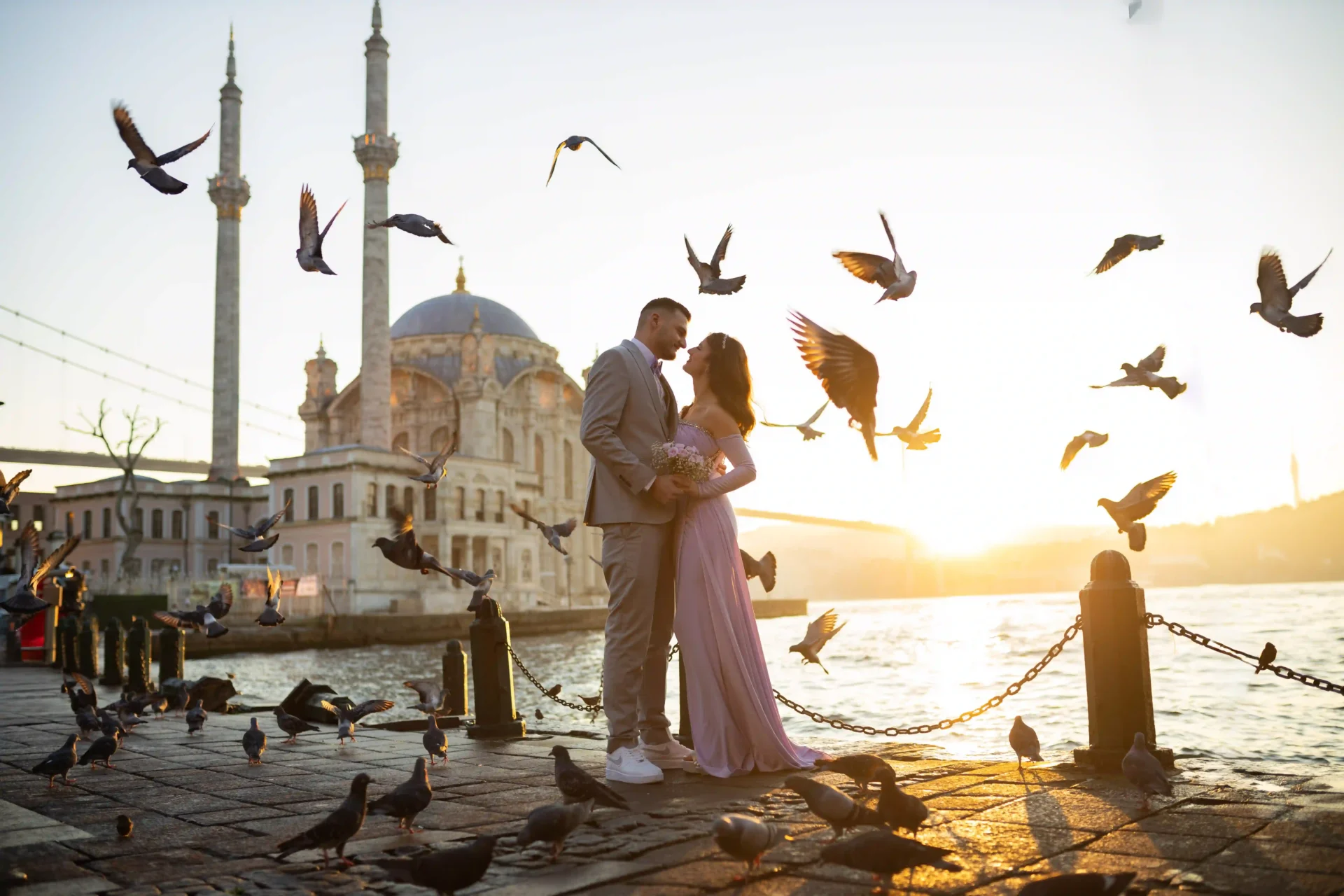
Let me create a picture in your mind. It’s 7:00 AM in November. The city is still quiet enough to hear your footsteps. Soft clouds drift in from the east, as if they’re waiting for the sun to give them permission to glow.
Then it happens: the light breaks through in gentle pieces, never too harsh, never too perfect, just enough to turn the Bosphorus into a sheet of silver. The water shimmers. The birds take their places like loyal actors who never miss a scene.
And the Bosphorus Bridge rises above everything, calm and powerful, while the Ortaköy Mosque stands behind it with that unmistakable Istanbul elegance.
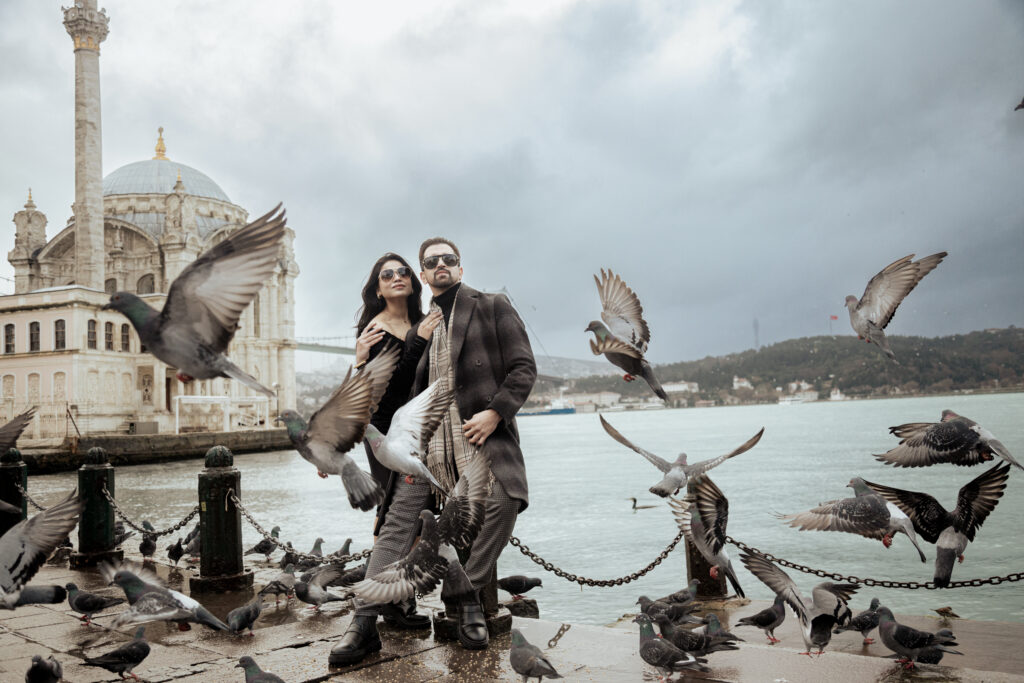
In that kind of light, you don’t need to force anything. You don’t need “poses.” You just need a real moment—two people close, a quiet laugh, a kiss that happens naturally—then suddenly it’s not just a photo anymore.
It’s proof. Proof that you were here, that you felt this, that Istanbul gave you one of its most beautiful mornings.
“Ortaköy isn’t just a location—it’s a mood made of water, wind, and Istanbul light.”
What You’ll Learn About Ortakoy Photography in This Guide
“This guide is written from a local photographer’s perspective—so you can plan your Ortakoy photoshoot without guesswork.”
- The best photography spots in Ortakoy (iconic frames + quieter corners most tourists miss)
- A simple shooting map: where to stand for the mosque + bridge frame, and where to go when it’s crowded
- The best times to shoot (sunrise / morning / golden hour / night—plus what each time is best for)
- Crowd & vibe guide: when it gets busy, when it feels calm
- Outfit & styling tips that match the Bosphorus wind, cobblestones, and the Ortaköy “tourist vibe”
- Comfort & safety notes (what feels comfortable to wear, and how to stay relaxed)
- Weather-proof tips
- How to get there easily (walk from Beşiktaş, taxi/app tips, buses from key areas, metro + bus, ferry options)
- Photography style ideas: travel portrait, couples, fashion/editorial, flying dress, street/documentary, and low-light/night
- Local “save your shoot” tips (the waves, the wind, the busy-hours truth, and the best backup angles)
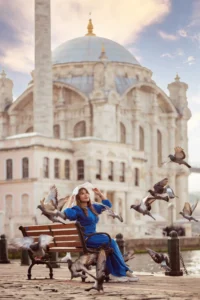
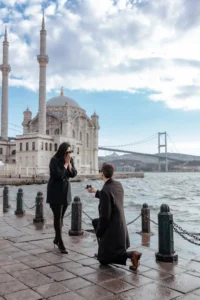
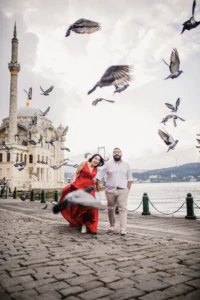
That’s why Ortaköy never gets old for me. Every time I return, I notice a new detail: the rhythm of the waves against the stone, the sudden wind that makes fabric dance, the fisherman patiently waiting.
Of course, the situation in Ortakoy will not always remain like this..The crowd slowly wakes up. The neighborhood shifts from calm poetry to lively street energy. Ortaköy doesn’t stay the same long enough for you to get bored—because it’s not a “location.” It’s a mood And honestly, it’s hard to imagine traveling to Istanbul and not coming here at least once. Whether you’re chasing sunrise frames, enjoying a calm breakfast by the shore, or walking into the evening when the lights begin to sparkle and the Bosphorus feels endless—And this is where the story begins. A story that will be more than just a photo for you.
Where is Ortakoy Located in Istanbul for Photoshoots
Ortaköy is on the European side of Istanbul (the west side of the Bosphorus), right on the waterfront, in the Beşiktaş district (Beşiktaş). If I want to be more precise: it sits on the coastal strip between Beşiktaş/Dolmabahçe and Arnavutköy–Bebek, right beside the European foot of the Bosphorus Bridge.
In terms of “how central it feels,” Ortakoy is semi-central: not inside the Historic Peninsula (Sultanahmet/Eminönü), and not far north like Sarıyer. It’s on the central Bosphorus line—close to major urban centers like Taksim and Şişli, while still giving you a direct, dramatic view of the Bosphorus and the bridge.
How to Get to Ortakoy for a Photography Session
You can reach this waterfront in several ways.
1) On foot
If you’re near Beşiktaş and you’re in the mood for a walk, you can experience a dreamy route that takes about 40 minutes on foot.
Beşiktaş is one of Istanbul’s most famous, busiest, and most traffic-heavy areas. A historic, flashy, coastal road on the European side, moving north along the Bosphorus.
And don’t worry: like many Istanbul locations, you won’t face steep uphill or downhill sections here. It’s mostly a flat walk—and a beautiful one. I recommend it even if you arrived here by metro or car.
Locals call this route “Beşiktaş,” but as you move forward, the street name changes depending on the famous places along the way, such as:
- Dolmabahçe Palace (Dolmabahçe Palace)
- Dolmabahçe Mosque / Bezm-i Âlem Valide Sultan Mosque (Dolmabahçe Mosque)
- Istanbul Naval Museum (Naval Museum – Beşiktaş)
- Barbaros Hayrettin Pasha Tomb & Square (Barbaros Hayrettin Paşa Türbesi) (in Beşiktaş Square; a few minutes before/after the start of the coastal route)
- Çırağan Palace (Çırağan Palace) (between Beşiktaş and Ortakoy)
- Feriye Palaces (Feriye Palaces / Feriye Sarayları) (a series of Ottoman waterfront buildings after Çırağan)
- Yıldız Palace & Yıldız Park (Yıldız Palace & Yıldız Park) (above the coast; a short turn inland)
- Ortaköy Mosque (Büyük Mecidiye / Ortaköy Mosque) (Ortaköy Square)
As you continue, the road becomes Çırağan Avenue (Çırağan Caddesi), and you’ll reach the Ortaköy waterfront.
Because the waterfront sits behind the Ortaköy market area and isn’t directly attached to the main road, you may get confused the first time. To avoid that, here are the best routes:
Route A: Vapurskelesi Street
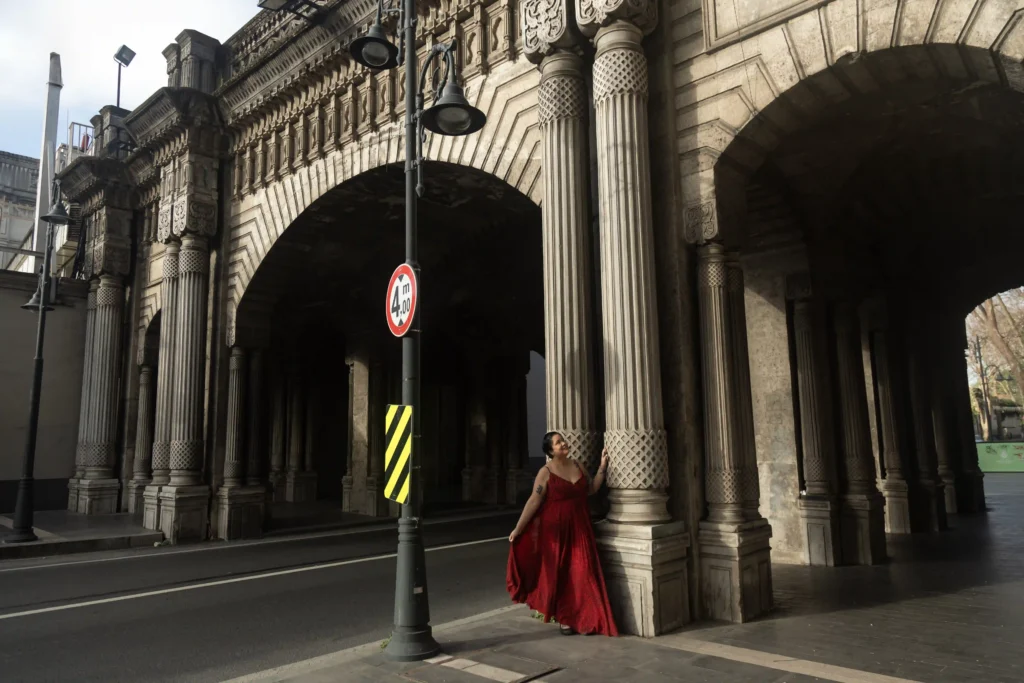
On the way, you’ll see a passage known as “Çırağan” — it’s like a short bridge/gateway: a grand stone arch sitting over Çırağan Avenue. Cars and people pass underneath it, as if the city briefly pulls you from traffic into a piece of official, royal architecture. It’s the only such passage on that street. In my opinion, one of the best places for photography. After you pass it, you’re close to Vapurskelesi Street (right after the traffic light). This side street takes you to Ortaköy Pier.
Route B: Mecidiye Köprüsü Street (Mecidiye Bridge Street)
If you continue along the road before reaching the Bosphorus Bridge (which will be right in your view), you’ll notice a market-like entrance on the right. Enter it and you’ll suddenly see a colorful little corridor by the Bosphorus—full of tiny handmade items and the smell of waffles. This is the famous Ortakoy market area.
It’s a crowded corridor with snack sellers calling out to you, small lights on the tiny displays, and—just a few steps away—the smell of kumpir and waffles pulling you toward the coast.
Many people love this street for its “in-between” feeling—like a market that grew under shade. The shade is cool in summer, and then with a few steps your eyes open to the water and the wide Bosphorus space.
The routes between these two streets
Between these two streets, if you enter any alley on the right side, you will eventually reach the waterfront. These alleys are often narrow. As you step inside, you enter a half-shaded space with rows of small stalls. Usually you’ll find costume jewelry and handmade accessories, art gifts, crafts, mini paintings, ceramics, scarves, and decorative pieces.You will also see cafes, restaurants, and small and stylish hotels along this route.
Important point:
very early in the morning or late at night, because they can be quiet and darker, I don’t recommend these routes. But during busy hours, they are very attractive for curious tourists.
2) Booking a ride (Uber / taxi apps)
If you don’t feel like walking—or you’re in a hurry—this can be the best option, as long as traffic isn’t heavy. Most car routes connect to Beşiktaş’s traffic-heavy roads. Sometimes the traffic is so intense that you can get stuck for a long time.
The best hours for using a car vary by season. In summer, from early morning until around 10:00 is usually best. On days when schools and universities are active, around 8:00 is often one of the worst traffic times. I recommend using traffic apps to check congestion before you go.
Next: pricing. Unfortunately, some taxi drivers—once they realize you’re a tourist—may try to charge more. Whether you take a yellow taxi or book through an app, make sure the taximeter (usually mounted near the mirror) is on. Whatever it shows at the end is what you should pay in Turkish lira. It’s always smart to carry some cash in TRY.
3) Bus (safe and convenient)
Istanbul’s public transport is extensive and tourist-friendly. It’s not perfect, but overall it scores above average. One of the key tools is the Istanbulkart.
You can get it at the airport from the designated kiosks/counters. If you couldn’t get it, no worries. You can also use your bank card—buses and metros support contactless payment as well. With either of these, you can use buses to reach Ortaköy.
Staying around Taksim? Take: 40T, 42T, DT2
Coming from Eminönü? Use: 30D
Starting in Mecidiyeköy? These work well: DT1, DT2
Tip: even if you know the line, you can still ask the driver “Ortakoy?” and they’ll usually confirm whether that bus stops there.
4) Metro
Riding the metro in Istanbul isn’t just transportation—it’s part of the city’s charm. In a few minutes, you travel from historic streets to modern neighborhoods, watching faces, moods, and everyday life change with each stop—simple, real, and surprisingly captivating.Therefore, you can use the following lines:
Metro + bus: Take M2 → get off at Gayrettepe → then bus 22 / 40 / 25E to Ortaköy.
5) Ferry (a scenic option)
One of the most beautiful ways is taking the ferry. A practical option is the city ferry line that connects Ortakoy – Beşiktaş – Eminönü. This ride gives you stunning Bosphorus views along the way, so the transportation itself becom
Best Ortakoy Photography Spots and Practical Tips
Although I’m writing this blog for the Tripskeeper platform—and I can honestly say Tripskeeper gives you professional, smart tools for choosing the best time, the best location, and even the best photographer aligned with your needs for booking a shoot—this doesn’t mean I won’t share practical photography tips with you.
After reading this section, you’ll know the best corners of Ortaköy and you’ll learn the photography “tricks” for capturing this magical location.
Essential Photography Elements for Ortakoy Photoshoots
The magnificent sunrise of Ortakoy
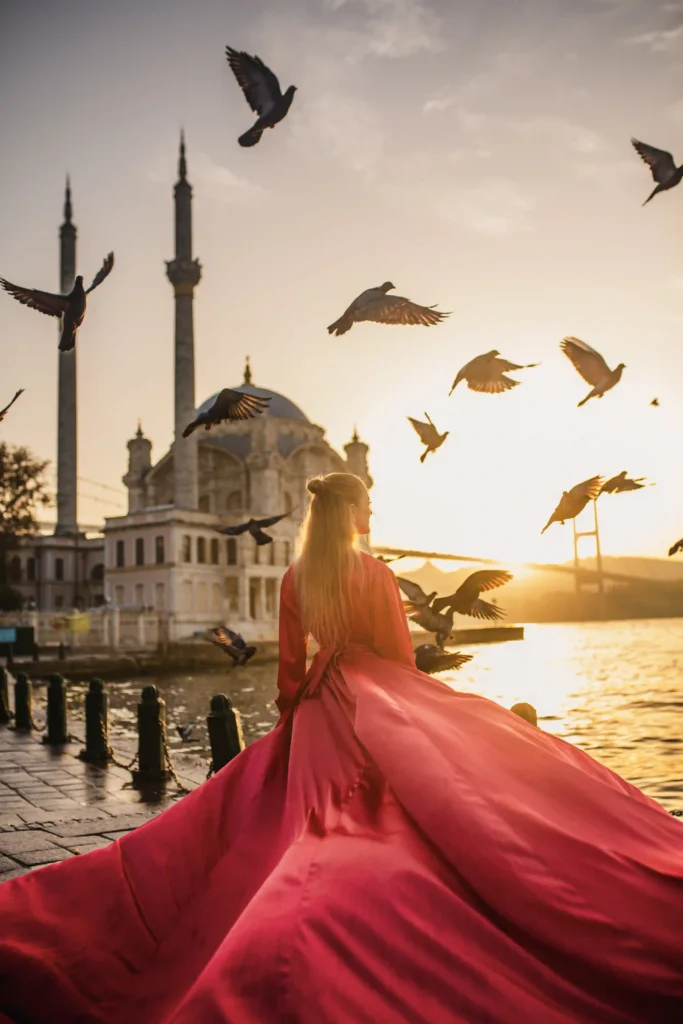
Let me start with sunrise. When you stand near the Ortaköy Pier station, on the southern side of the mosque, the sun usually rises behind and around the mosque.
It then moves upward along the line of the mosque and the Bosphorus Bridge. In the morning—both before and after sunrise—this creates a spectacular view: a dramatic background, a mix of nature, modernity, and tradition, and the reflection of all three in the water.
If your portrait becomes part of that frame, it almost always becomes your most special photo.
In my opinion, the best time to shoot in Ortaköy is exactly this hour: sunrise. Sometimes it’s around 5:00 in summer, and around 7:00 in autumn. In summer, you have more time to play because the sun stays behind the mosque longer, and your photos are full of contrast. As we move toward autumn, the sunrise point shifts farther from the mosque—this is where you get the most dramatic scenes. If you’re in Istanbul in autumn, never miss Ortakoy sunrise photography in this season.
Ortaköy Mosque and the Bosphorus Bridge — a timeless frame
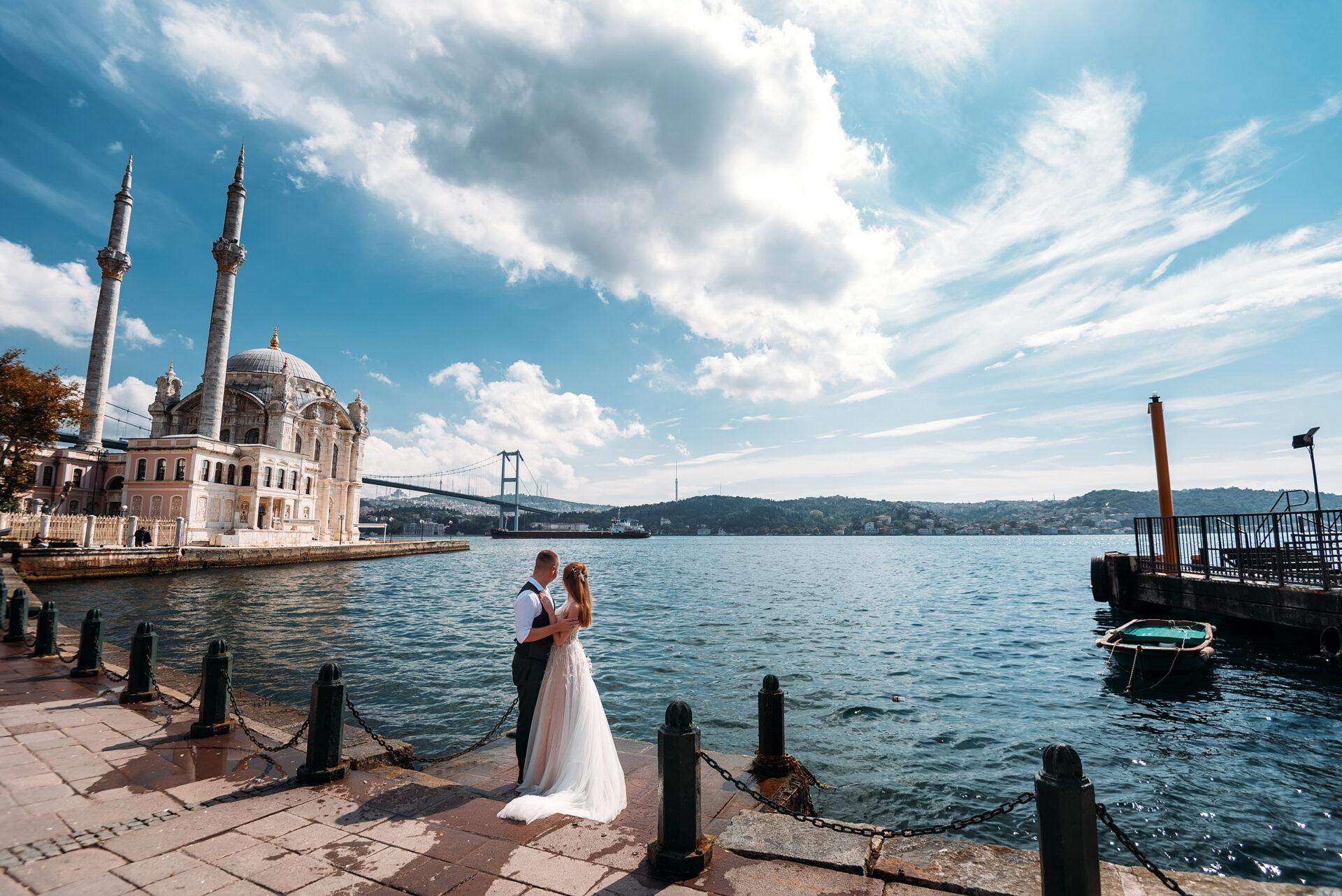
The most iconic photography spot in Ortaköy is without a doubt the Ortaköy Mosque—standing elegantly beside the water. Its Ottoman-Baroque architecture, bathed in soft natural light, creates a stunning focal point.
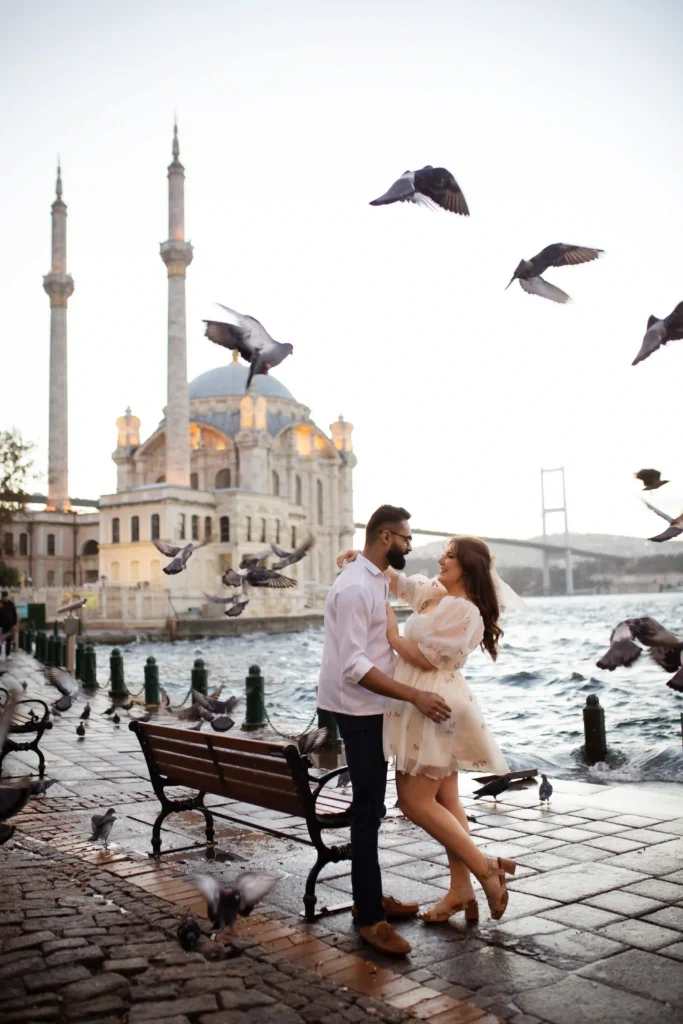
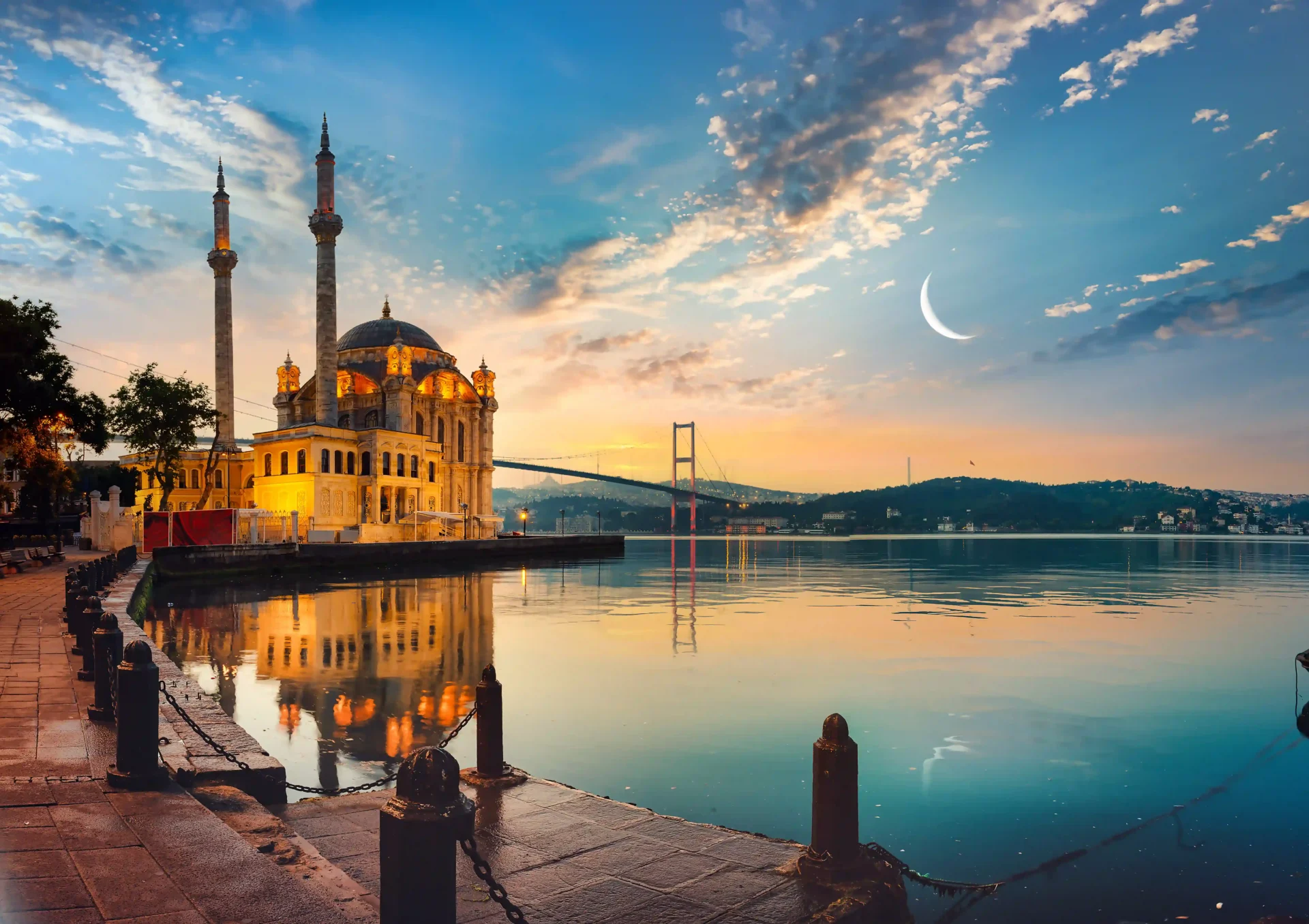
The mosque’s reflection in the shining Bosphorus water adds a dreamy layer and makes it one of Istanbul’s most beautiful historic buildings.
The Bosphorus Bridge looks like a “ready-made frame” for photography: the bridge sits right above your composition, the towers act like strong vertical lines holding your image, and the cables draw a delicate net across the sky. The bottom of the frame is usually the Bosphorus itself—a living surface that breaks light, and with each wave, changes the texture of your photo.
The magic is that inside a single frame you can have scale (the giant bridge), life (boats, movement, birds), and a “character point” like the Ortakoy Mosque—if you shift your angle slightly, it becomes your classic, poetic foreground.
At night, the bridge lights turn into a floating line of light and the Bosphorus becomes a shattered mirror—exactly the kind of detail that upgrades your photo from “a view” to “a scene.”
The waterfront, cobblestones, wooden benches, and the birds that are always in the scene
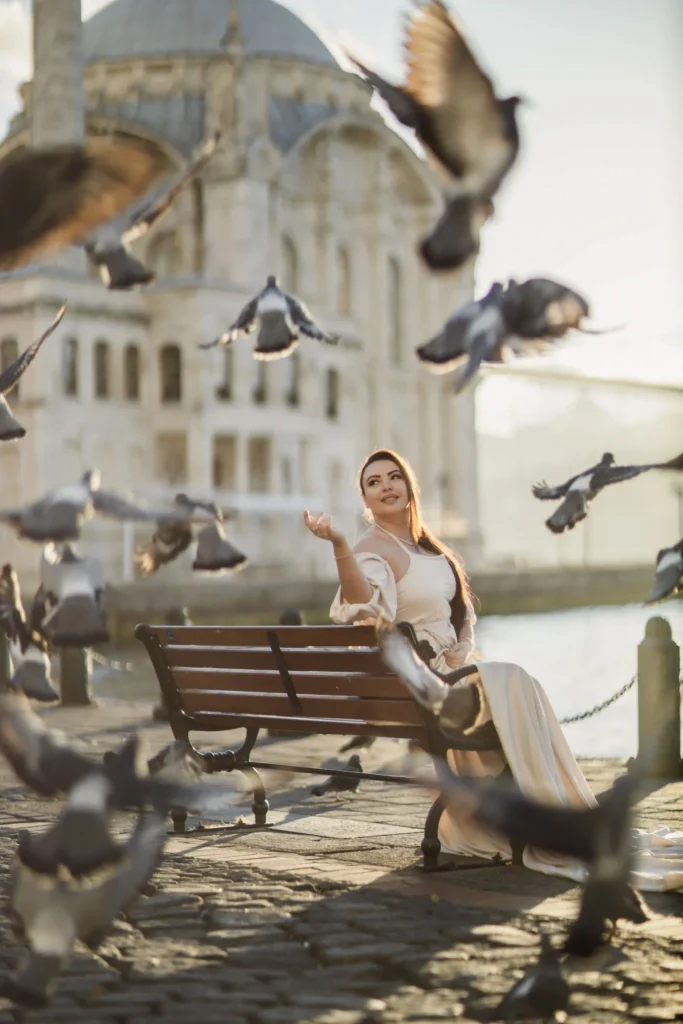
Ortakoy Beach looks as if the city itself has set the stage for the photo shoot. The cobblestone walkway sits quietly under your feet like an old texture, and its fine lines guide the eye—like a natural leading line pulling you toward the water.
The wooden benches are warm, human anchors in the frame. The wood’s color and texture, against the cool stone and Bosphorus blue, creates a poetic contrast: nature/city, hard/soft, cold/warm.
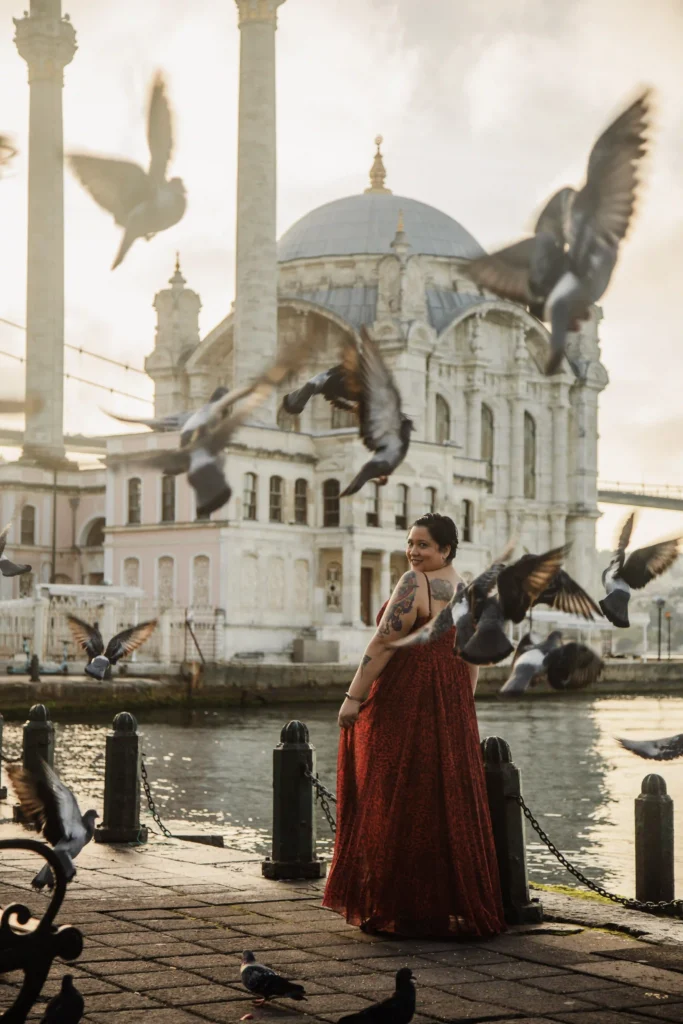
And then… the birds. They are the always-present “living element”—the thing that saves the frame from becoming a static postcard. Every time they fly or land on the stone edge, they give rhythm to the image: a small moving point that makes the eye travel between bench, stones, and shoreline.
Artistically, this combination is “minimal with details”: simple elements (stone, wood, water, birds) but each has texture and personality. If the light is good, they build a calm story together—a story of pausing, looking, and breathing beside the Bosphorus.
Golden rule for aesthetics here: play with textures. Keep cobblestones in the foreground, place the bench as your warm anchor, and capture the birds like musical notes near the horizon line or close to the water. The result is usually a photo that feels both real and poetic—without forcing poetry.
The north side of the mosque
Behind the Ortaköy Mosque—on the quieter side near the market—there’s a piece of Istanbul that strangely appears less in most tourists’ frames. Here, the waterfront is not just a “view.” It becomes a complete stage for photography.
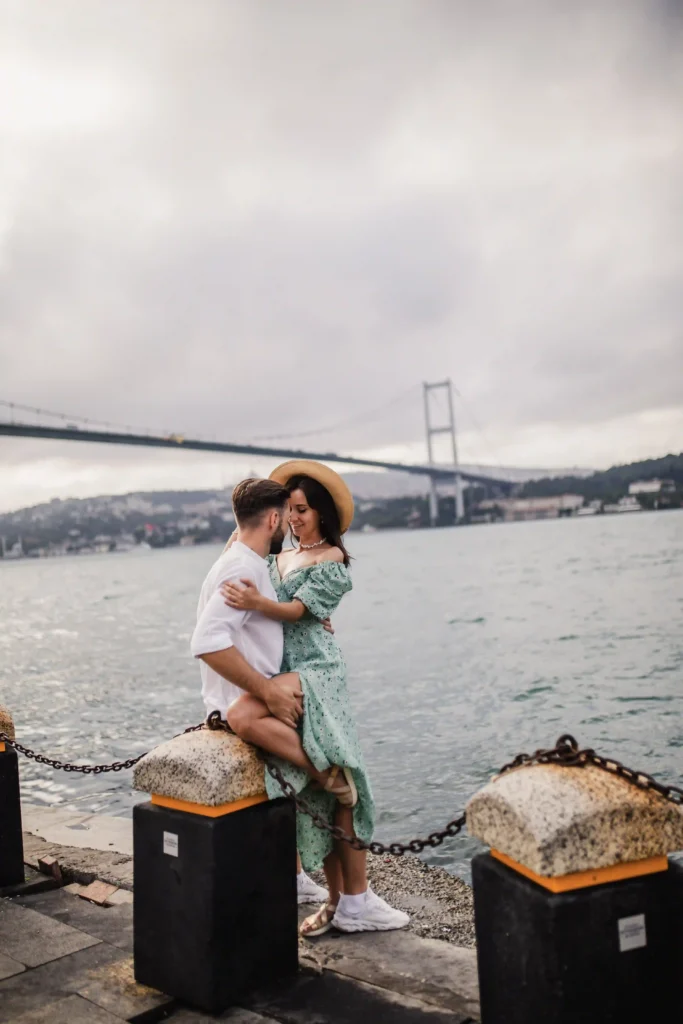
The stones under your feet act like an old urban texture, and the row of short columns by the water is exactly what photographers fall in love with: a rhythmic pattern that carries your eye from foreground to the Bosphorus.
Those columns give your frame direction. Build the bottom of the frame with them and the viewer’s gaze naturally moves toward the water, the boats, and then the bridge. In the middle of that path, you’ll often find fishermen—quiet, simple people who add “life” to the image with one fishing rod.
The contrast is powerful: simple daily routine versus the enormous Bosphorus Bridge—this contrast pulls your photo away from postcard and into visual storytelling.
From this angle, the mosque also becomes a new character. It’s no longer the classic front view everyone has already seen. Instead, you feel its volume and lines in a more real, closer way.
The result is usually a multi-layered photo: stone and columns in the foreground, people (and sometimes birds) in the middle, and the open sky and bridge in the background—three layers that make the image both clean and cinematic.
And because the sun is often in front of this side, it acts like a natural softbox for lighting.
If I had to say it in one sentence: when you go to Ortakoy, experience the north side too. Behind the mosque, Istanbul doesn’t just “look beautiful”—it starts telling a story.
Cozy cafés and street food — a delicious frame
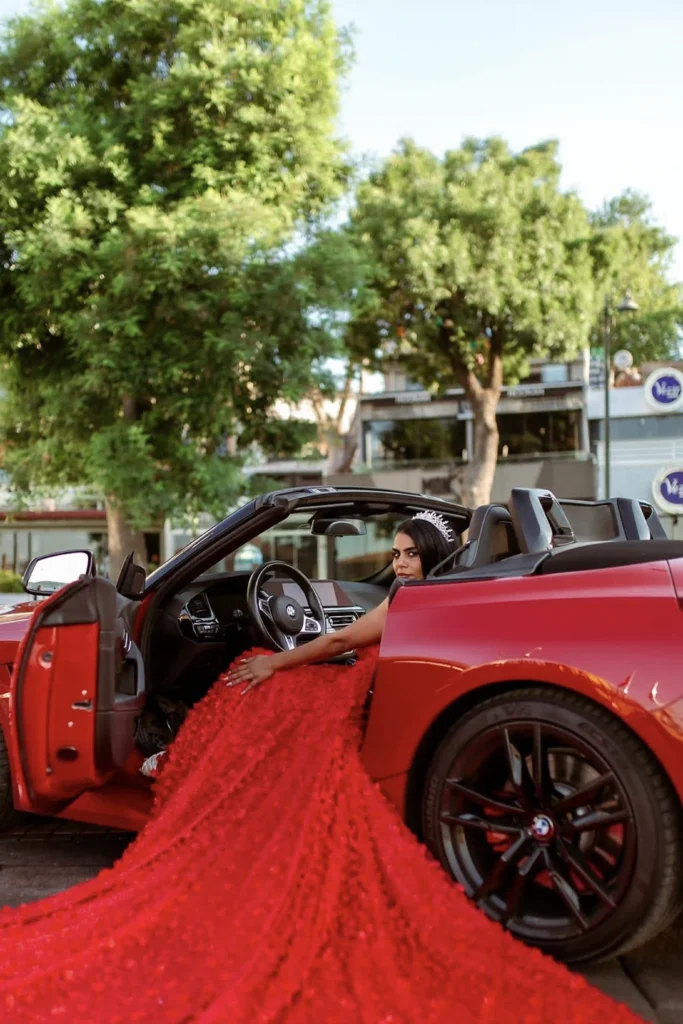
Ortaköy offers a wonderful environment for street photography. Cobblestone alleys, colorful walls, and lively cafés create warm, intimate backgrounds that bring local atmosphere into your photos.
Order a traditional Turkish coffee, hold the cup in your hands, and capture a small moment with historic streets behind you—perfect for an authentic Istanbul lifestyle shot.
Ortaköy is also famous for its street food, which makes it a great place for food photography. The most iconic food here is kumpir—a baked potato filled with colorful toppings.
A close-up photo of this vibrant dish not only looks appetizing, but also shows the local flavors of Istanbul.
What to Wear for a Photography Session in Ortakoy
Dressing well here isn’t only about looking stylish—you’re negotiating with the Bosphorus wind, daylight, cobblestones, and the bridge backdrop. The best outfit is one that looks great in photos and still feels comfortable and reliable in real life.
First colors
Ortakoy is full of blue water and sky, gray stone, and a little scattered green. To avoid fading into the frame when taking photos on Ortakoy Beach, colors like cream, warm white, beige, camel, light olive, deep navy/green, soft burgundy, or classic black go beautifully together. Neon colors or busy patterns often fight with the busy market background and movement, making the photos feel tired.
If you’re not a minimalist, that’s fine—just keep it to one “color point”: for example, a burgundy scarf or a deep navy bag.
Form and movement
Ortaköy means wind. Clothes with movement always win. In fact, photography without form and movement is never alive. light coats, a well-shaped scarf, a midi skirt, or a dress that comes alive in the breeze.
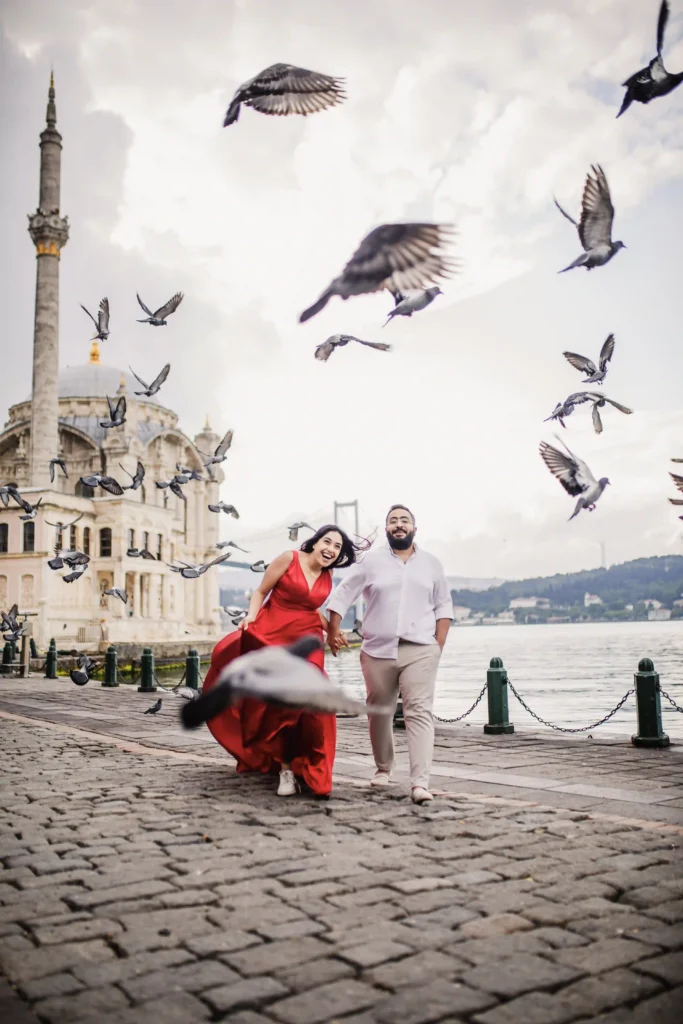
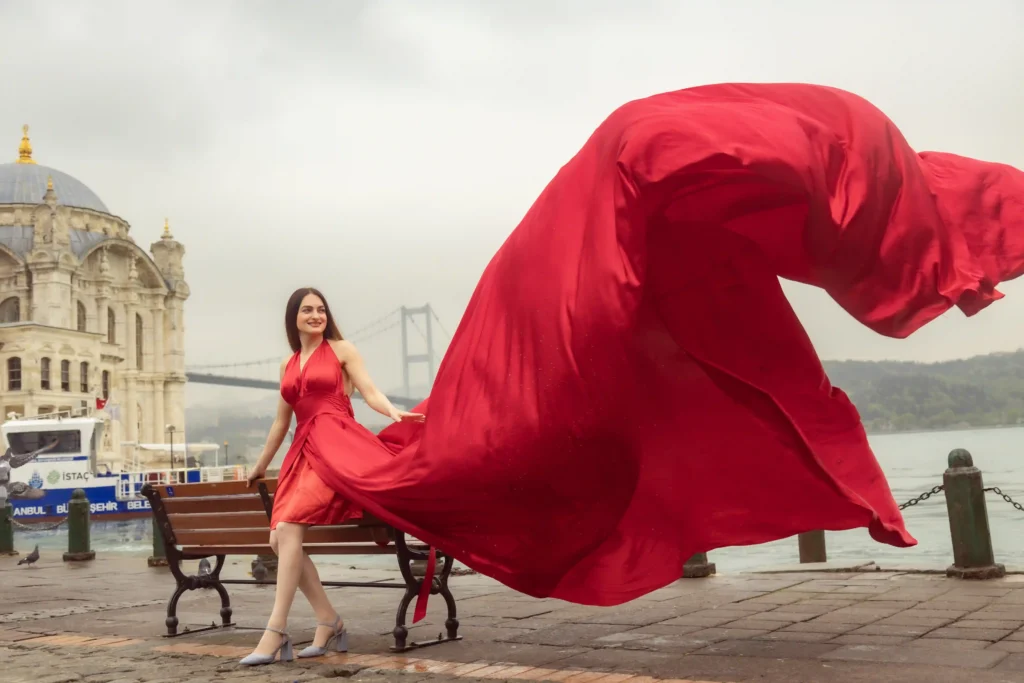
And here is one of the best places to add a special experience: Flying dress Istanbul Ortakoy.
If you do your shoot with a professional local photographer, you’ll have access to these dresses. In fact, many Tripskeeper products include them.
To see packages and portfolios of local Istanbul photographers, click here.
In this style, the fabric’s movement becomes part of the composition; the Bosphorus wind works like a lighting assistant and stylist, and the result is usually frames that are both dramatic and soft.
Istanbul is famously known for Flying Dress. Many photographers either have dress options or can arrange rentals—you just need to check the product description or message before booking.
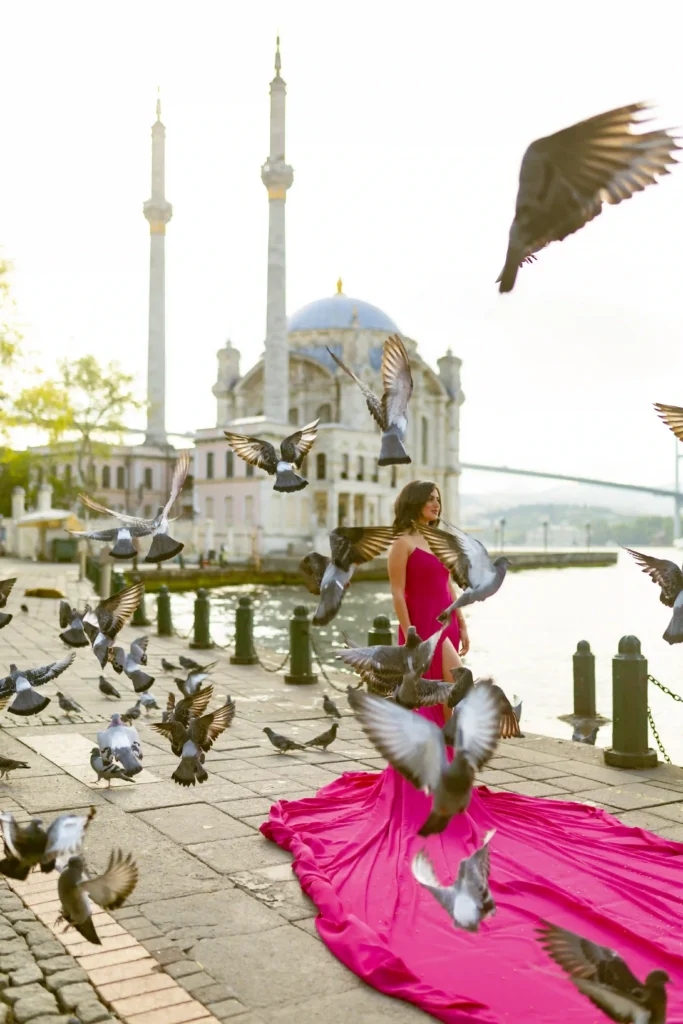
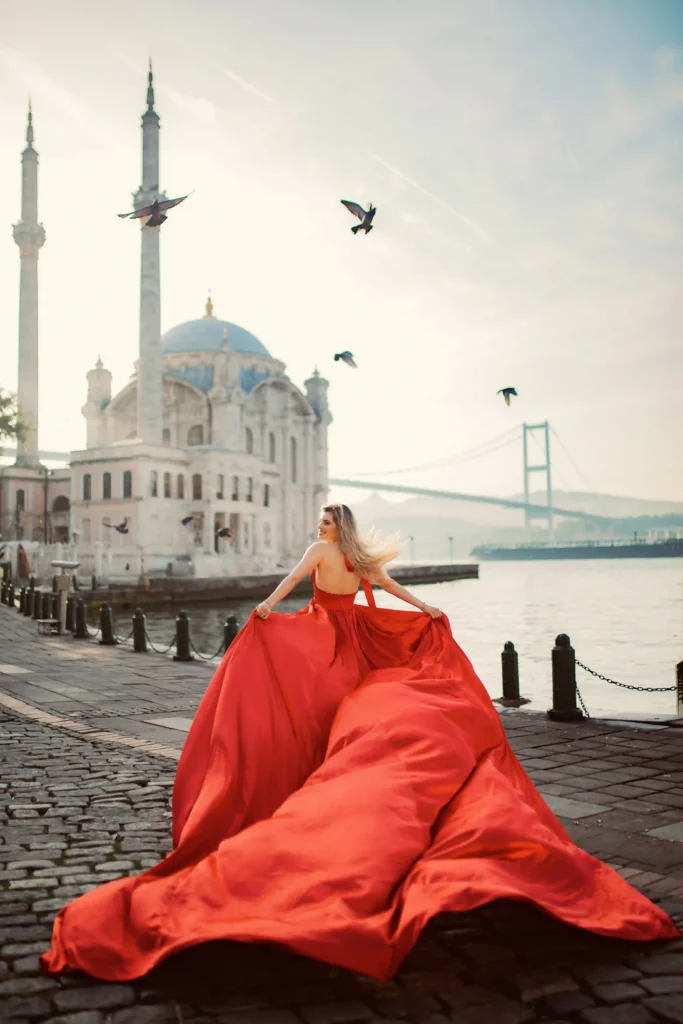
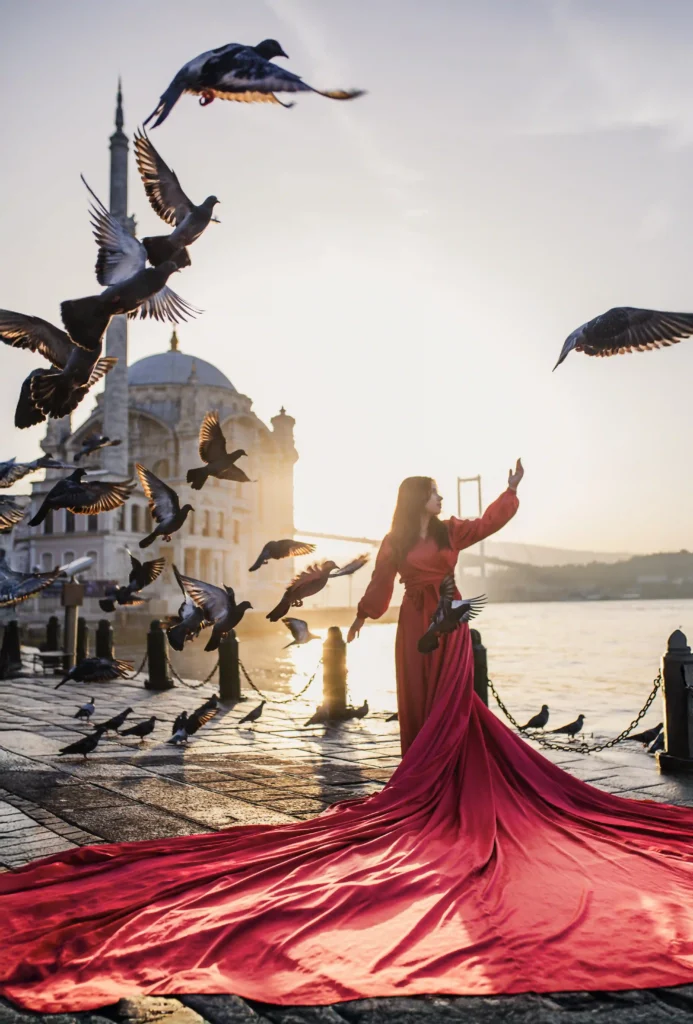
Want to quickly see all Istanbul options and filter between them? The Istanbul products page gives you that choice. You can even ask our AI to recommend the most suitable products for you.
Now the most important part: shoes
Ortakoy cobblestones do not joke with the wrong shoes. If you want to walk and pose, clean simple sneakers, loafers, or comfortable short boots are best. Very high heels or unstable shoes make walking painful and push you away from natural posing in the photo.
A comfortable shoe lets you truly interact with the space: sit by the columns, walk along the shore, play with the wind—without your mind being busy with foot pain.
If you insist on heels, it’s better to carry them and only use them during specific frames—but the process will become more difficult.
Layering matters here too
Even if the weather is nice, wind by the Bosphorus can suddenly feel cold. A light layer like a short trench coat, denim jacket, cardigan, or soft blazer completes the style and saves you at sunset or night.
Minimal Accessories for Ortakoy Photoshoots
Less is more here.
A well-chosen sunglasses frame, a simple watch, delicate earrings, or a small stylish bag is more than enough. Ortakoy is already full of visual details, so too many accessories only add unnecessary noise.
If you wear a scarf, choose a fabric that keeps its shape in the wind—this helps you stay relaxed and avoids constant adjustments during the photoshoot.
In short, the philosophy of dressing in Ortaköy is: you should stand out from the landscape—but not fight it. Choose something that speaks “chic and simple” with Bosphorus light and bridge lines, and is comfortable enough to truly live the moment—because the best photos are always those real moments.
I suggest that if you have booked local photographers from TripsKeeper, be sure to coordinate this before the shoot.
Ten Important Things You Need to Know for Ortakoy Photography
1.Clothing Safety in Ortaköy: what to wear in Ortakoy photoshoot?
A Local Reality Check
Ortaköy is one of the most touristy and liberal coastal areas in Istanbul, and in terms of clothing, you generally have full freedom—from casual to elegant and even more open styles. Just keep in mind: early morning photography can sometimes overlap with nightlife people leaving cafés and bars—especially near sunrise. If you booked a local photographers from TripsKeeper, don’t worry; they can manage the situation. If you’re going alone, knowing this can help your clothing choice and your comfort. Police presence is usually there and safety is generally maintained, but if you’re sensitive, bring an extra layer and avoid standing too close to groups that feel uncomfortable.
2.Cover inside the mosque
If you plan to visit the Ortaköy Mosque or enter inside, it’s better to choose a more modest outfit out of respect (more covered clothing; for women a light scarf is useful). For shooting by the Bosphorus, the main issue is not clothing restrictions—it’s the wind and cobblestones: comfortable shoes and a light layer are always lifesavers.
3.Take care of your personal belongings
Ortaköy is generally touristy and safe, but like any crowded area, keep an eye on your belongings—especially when you’re fully focused on framing and photography. If you use a local photographers from TripsKeeper, they help a lot. Still: keep phone and bag close, wear your camera strap, don’t leave items on benches or the sea edge, and if you work with multiple tools (lens, tripod, flash), having one person watch gear helps a lot.
4.Extra costs with birds
around the wooden benches, you’ll see people I call “bird man.” They sell grain to attract birds toward you so your photo feels complete. This is great because it gives your photos a special, vivid look. But Watch for extra charges—some may ask for more than it’s worth. If you booked professional local photographers, let them handle it, so you can add birds with less cost and less stress if you want.
5.The best time for professional photos
The best time for clean, professional photos is usually from sunrise until about two hours after. In that window, light stays soft, shadows are more flattering, and faces look natural. As you get closer to 10:30–12:00 (especially in spring and summer), the light becomes harder and more direct—and the area gets busier—so controlling light and finding empty frames takes more time.
6.Shoes
as I said, Ortaköy cobblestones—despite all their beauty—make shoe choice important. Match comfortable shoes with your outfit, and if you absolutely want heels, carry a backup pair and use heels only during the shoot.
7.When It Gets Busy: The Crowd Effect on Your Photos
Crowded times can ruin “polished” photography. Especially weekends and evenings: heavy movement makes backgrounds messy, clean angles become harder, and the team loses focus.
best time to take photos in Ortakoy
If you want cinematic, quieter frames, go early morning or near sunrise; weekdays before evening crowds are also calmer. But if you do documentary/street/social photography, it’s the opposite: crowd is the fuel. People walking, vendors, food, cafés, alleys, fishermen, birds, natural reactions—this creates rhythm and real energy. Instead of escaping the crowd, you can use it as a narrative background.
8.The Ortaköy Tourist Vibe
Tourists who choose Ortaköy are often different from those who only check “must-see” spots like Sultanahmet. Sultanahmet is a planned destination: tours, lines, classic photos, checklist tourists.
If we ask an Ortakoy photography guide, the answer would be this: Ortakoy feels more like “Bosphorus life”
walking, cafés, waffles and kumpir, watching the bridge, sitting by the water—more experience than checklist. In photos, you’ll often see more relaxed, better-styled, experience-seeking tourists—couples walking without strict plans, people listening to street music, or simply coming to breathe beside the Bosphorus. For documentary photography, this difference matters: Ortaköy gives you people who live more “in the moment,” so frames feel more natural and story-driven.
9.Watch out for the waves on the beach
A funny (and slightly surprising) thing: when large ships pass through the strait, water current changes and waves can suddenly hit the stone shore faster. Even if everything looks calm, a quick strong wave can arrive and soak you—especially if you stand close to the edge or if your equipment is near the water. So don’t stand too close, don’t place bags/gear on stones near water, and watch the waves for a few seconds after ships pass. Local photographers know this well—they recognize the timing. Sometimes this very moment creates special frames.
10.Seasonal winds
The Bosphorus wind is always one of Ortaköy’s main actors. In summer you may feel it less, but in autumn you often face it more consistently. It’s excellent for Flying Dress because it adds natural dramatic movement to fabric. But if hair is loose or clothing is very light/open (especially for women), controlling hair and outfit shape in the frame can become harder and take more time. If you like very open/light outfits, you may have a bit more struggle controlling them in wind.
“If you want clean, cinematic frames here, a local Ortakoy photographer can time the light and crowds for you.”
What Photography Styles Ortakoy Is Best Known For
Ortaköy is a “multi-purpose” location. Depending on the hour and angle, it can be postcard-romantic, documentary-busy, fashion-dramatic—everything. Here are its best styles and scenarios:
1) Travel Portrait & Urban Lifestyle
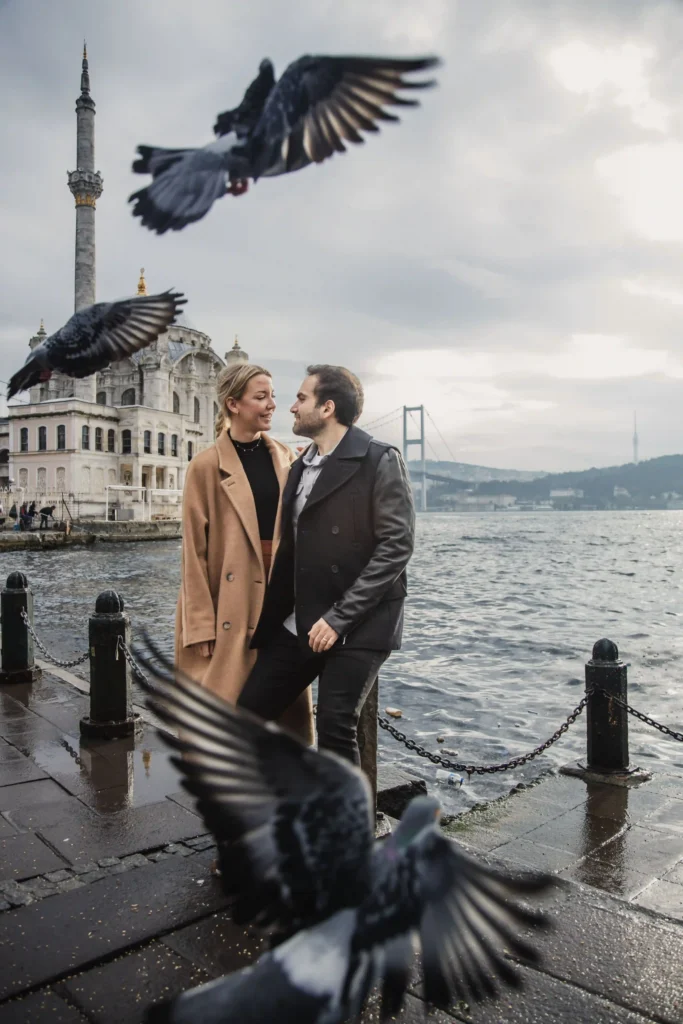
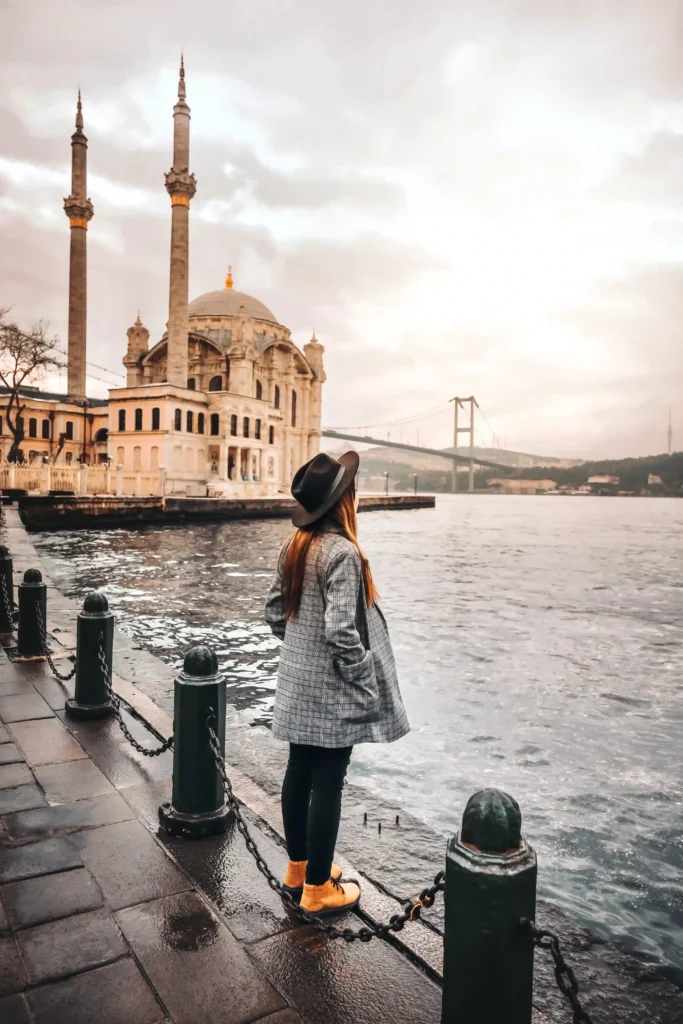
The Bosphorus background, benches, cobblestones, cafés, and people movement give your photos “life.” Perfect if you want natural, non-stiff frames.
2) Couple / Engagement / Romantic
Ortakoy is one of the best places for couples because:
- The bridge and water create a strong backdrop
- With the right angle, you can still get quiet frames
- Perfect for walking poses, hugging, and natural laughter
(If the crowd bothers you, early morning is a miracle.)
3) Fashion / Editorial
If your styling is strong, the bridge lines and the rhythm of cobblestones and waterfront columns give structure to the photo. Fashion works best here when it’s minimal and elegant—not too busy.
4) Flying Dress
The Bosphorus wind is a natural effect. Flying Dress here can be both romantic and dramatic. Just watch sudden waves after big ships so the dress/shoes and even your gear don’t get wet.
5) Street & Documentary
If you want real Istanbul storytelling, Ortaköy’s busyness is an advantage: fishermen, vendors, relaxed tourists, birds, and shifting light on water. The “scene” is always changing.
6) Night / Low Light
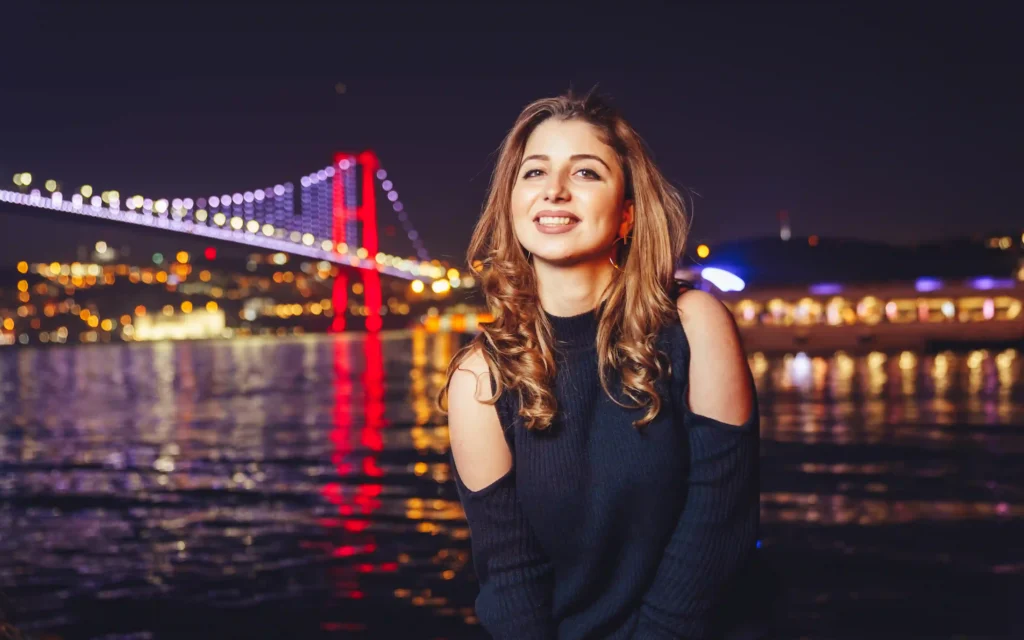
At night, bridge lights and reflections create cinematic frames. Great for night portraits, silhouettes, and even long exposure (if you manage equipment and safety well).
How Many People Is Ortakoy Photography Suitable For?
Solo photography
One of the best options—especially for travel portraits, city fashion, and minimalist Bosphorus frames. You can move faster and control the frame more easily.
Couple photography
In my opinion, this is the “best Ortaköy version.” Romantic frames by the water, café/urban frames, and classic bridge backgrounds—all in one session.
Family photography (3 to 5 people)
Absolutely suitable—with one important condition: timing. During heavy crowds, family shoots get harder because gathering everyone into a clean frame takes time, and kids get distracted by waves and cobblestones. Mornings or weekdays are much better. Lifestyle family frames (walking, playing, laughing) often look better than stiff formal posing.
Friends group photography (4 to 8 people)
Very doable and fun, especially if you want energy and memories. But for a clean group photo: you need a good standing spot and the background can easily get crowded. Pro solution: capture movement/documentary frames (walking, laughing, interacting) and do only one quick formal group shot at the end.
Large group photography (9+ people)
Not “ideal” unless you come at very quiet hours or you have a clear plan. Bigger groups mean more time, more attention to belongings, and harder clean framing. Best approach: a few quick group frames, then split into smaller groups (2–3 people) for better photos.
Practical summary: Ortaköy has the best payoff for solo and couples. It’s also great for families and small groups if you choose quieter timing. If you want polished editorial photos, emptiness matters more; if you want real documentary atmosphere, the crowd becomes part of the beauty. This is exactly where a professional local photographer from Tripskeeper can create two completely different outputs from the same location: “polished cinematic” and “alive story-driven.”
Exact Timing and Ideal Photography Conditions in Ortakoy by Season
This difference in seasons and hours is exactly where the value of a local photographer becomes obvious: someone who knows today’s Bosphorus light mood, which side of the mosque is quieter, when ship-waves rise, and where you can capture the bridge and you without crowd.
That’s why—if you want truly precise and professional results—the smartest move is to browse Tripskeeper and choose products that cover Ortakoy/Bosphorus with photographers who work there. They already understand the hour/angle/Plan B (wind, crowds, clouds). You simply arrive to the best part: enjoying the place and getting great photos. Still, the guide below helps you plan even more precisely.
1) Spring — the season of “kind light”
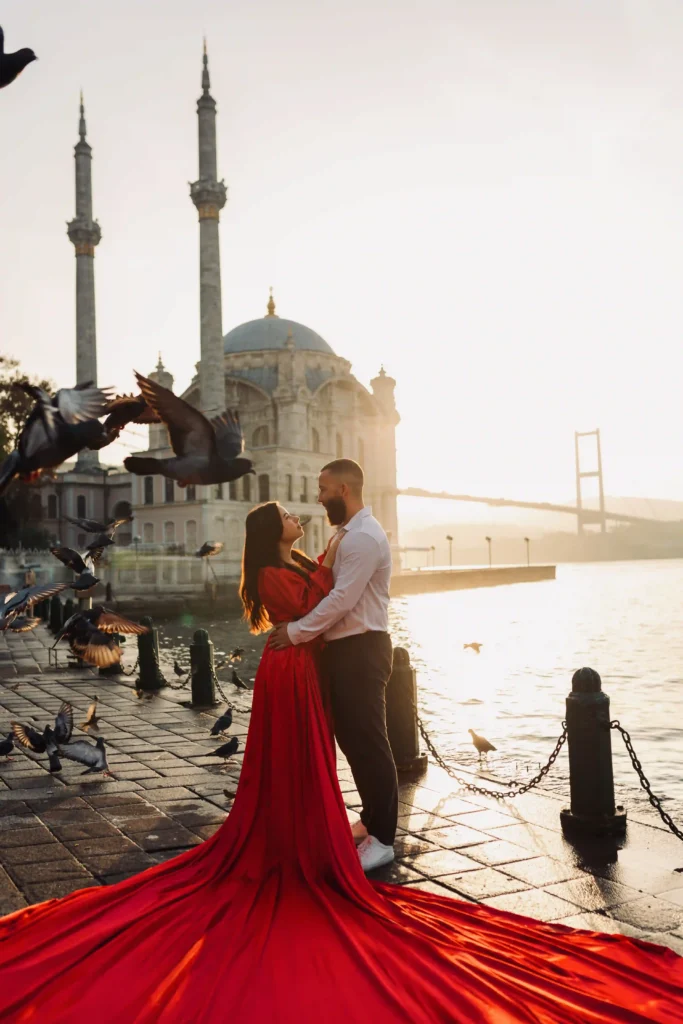
Spring is the season where colors feel fresh, skin tones look more natural, and the sky often has a soft layer that makes photos feel happier from the start. If you want travel portraits or romantic couple frames, spring is usually the least stressful: not the annoying heat of summer, not the sharp cold of winter.
In calendar months, this vibe is mostly March to May (sometimes early June still feels like spring). The best part is mornings: if you arrive around 6:30 to 9:30, light is still soft, the waterfront is quieter, and you can shoot clean frames calmly. From 9:30 to 11:00 is still good, but crowd increases and light gets harsher. After 11:00 to around 12:00, light often starts sitting harder on faces and photos can look “drier”—unless you intentionally want documentary busyness.
Outfit-wise, spring is layering season: a light jacket or thin trench over a simple shirt looks great and handles Bosphorus wind. Colors like cream, beige, light olive, deep teal, or warm white blend perfectly with the Bosphorus world—visible but not screaming. Just take shoes seriously: if stones are damp, they can be slippery; clean sneakers or comfortable loafers keep you natural and relaxed.
Golden spring tip that many misunderstand: if it becomes slightly cloudy, don’t worry—be happy. Spring clouds often work like a natural softbox: they spread and soften light. For portraits, that is exactly what photographers secretly pray for. I’m always a fan of shooting under spring clouds.
2) Summer — “sharp light and a shining Bosphorus”
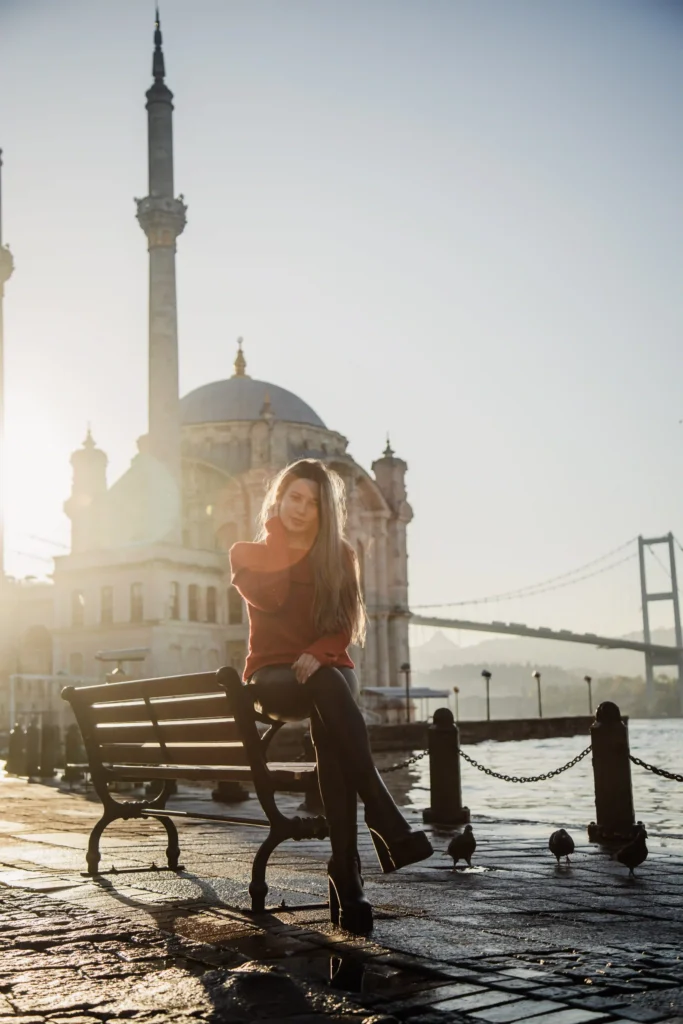
Summer is when the water sparkles, contrast rises, and photos feel more energetic. But summer has one simple rule: if you start late, the light becomes a sword on faces and everything becomes harder. It can destroy skin texture and make shadows difficult.
This vibe is usually June to August (sometimes early September). For clean professional output, take mornings seriously: the golden summer window is often 5:45 to 8:30—cooler air, calmer shore, and softer controllable light. From 8:30 to 10:00 you can still work (especially with shade or smart angles). But from 10:00 to 12:00 is usually hard for polished portraits: heat rises, light becomes harsh, crowds increase. Unless your goal is documentary city energy—then the chaos becomes your story.
For summer outfits, comfort and fabric matter most: quality linen, cotton, and matte fabrics are safe because they breathe and don’t shine under sun. Light and neutral colors usually work best, but watch very bright glossy white—it can “explode” in photos and lose fabric detail. Small essentials matter a lot: sunglasses, sunscreen, and water. They keep the experience comfortable and faces more relaxed.
Flying Dress in summer is also excellent—only with one condition: early morning. Noon kills fabric texture, makes faces tired, and makes dress control harder. Morning Bosphorus summer light is exactly what you want for a clean dramatic frame.
Golden tip: summer is the best season for minimalist portraits by the water. Find an empty frame and use morning light; the result often looks simple, chic, and magazine-level.
3) Autumn — the king of photography (a season of stylish drama)
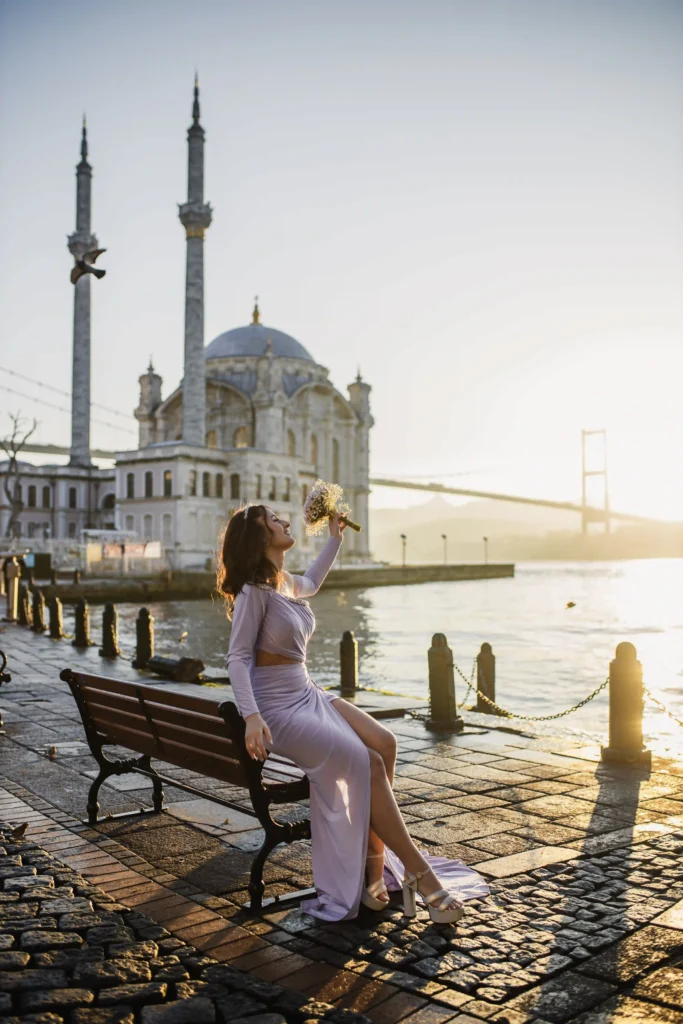
As an experienced photographer, if you ask me which season I love most for Ortaköy, I answer immediately: autumn. Bosphorus autumn is cinema. Light becomes warmer, skies become the main actor, and colors gain depth—neither too loud nor too dull. Calendar-wise, autumn Ortaköy is usually September to November; some years even early December still carries the feeling.
Autumn mornings are the best for clean professional photos while still enjoying city energy. If you’re there around 6:45 to 9:45, light is soft and shadows are flattering—perfect for fashion, editorial, and portraits that should look striking but natural.
From 9:45 to 11:15 is still good; you just need to watch crowd and shifting light direction. Near 11:15 to 12:00, light flattens more and the area gets busier; not ideal for heavily polished portraits unless you want documentary life.
Autumn is also the best season for chic layering: a thin coat, blazer, or light knit adds character in photos and matches the Bosphorus weather.
Colors become magical: chocolate, camel, burgundy, olive, and navy look warm and classic against Bosphorus blue and stone textures—especially if you want photos that feel timeless years later.
And the tip I always tell clients: if autumn is partly cloudy, be happy. Those soft clouds control contrast and capture skin beautifully—as if nature adjusted your lighting.
4) Winter — long shadows and special frames
Winter in Ortakoy may be less bright, but its light often looks “designed,” as if the city chose longer shadows to reveal more texture.
With the sun lower, cobblestones and waterfront edges show more detail. If mist or cloud sits on the Bosphorus, it can become a masterpiece—the quiet poetic mood that is harder in busy seasons.
Winter months are usually December to February (sometimes early March still feels winter). A big advantage: even near noon the light isn’t as harsh as summer.
Best window is often 8:00 to 10:30; from 10:30 to 12:00 is often still fine for clean portraits, especially if you want cinematic or documentary style.
Outfit rule: be warm but structured. A well-cut coat over warm layers looks serious and professional in photos. Small lifesavers: thin gloves (so you can use camera/phone), a simple hat for wind, and a scarf that adds texture.
Also: shoes matter. If stones are wet, anti-slip shoes give peace; otherwise your mind goes from posing to “don’t slip!”
Winter is unbeatable for portraits with a “quiet, poetic, real” feeling—especially weekday mornings when Ortaköy is calmer and you can play with light, texture, and the Bosphorus slowly.
Final Conclusion — How to Book Your Ortakoy Photography with a Local Photographer
To choose Ortaköy intelligently, choose time based on photography style—not only season. The same location can be a quiet cinematic scene at sunrise, and a few hours later become a story-rich street full of people.
If your goal is clean travel portraits, romantic couple frames, or minimalist fashion
look for times when the city is calmer and light is gentle with faces. These styles need cleaner backgrounds, light control, and focus on the subject. Instead of fighting crowds, use the hours when Ortakoy makes it easier: softer light, better-shaped shadows, and less background distraction. Then even a simple bench by the Bosphorus or the columns behind the mosque can become elegant high-end frames.
If you want street/documentary
It’s the opposite: crowds are not the enemy—they are fuel. 9:00 to 12:00 is often the best time for “story”: more people, more natural reactions, active vendors and fishermen, and moments that simply don’t exist in silent hours. In this style, you don’t clean the background—you use it. The crowd, motion, sound of the city, and Bosphorus energy become part of your narrative.
“For couples, solo travelers, and Flying Dress sessions, Ortaköy is one of the most flexible Istanbul photoshoot locations.”
If it’s Flying Dress
this style needs “the right wind + reliable light.” The best result usually happens very early morning: wind is easier to manage, faces don’t look tired under harsh sun, and you have space to move the fabric and create wider frames. Winter is also possible and can look very cinematic, but you must plan for cold and wind: the shoot becomes shorter, bodies get tired faster, and controlling fabric/hair becomes harder. The reward: if done well, the photos often look more special than other seasons.
Simple conclusion: Ortaköy in early morning is excellent for “polished, controlled” photos; closer to noon it’s excellent for “alive, story-driven” photos. Choosing time is basically choosing what kind of story you want to tell in Ortakoy.
Final conclusion — and the smartest way to book your Ortaköy experience
Istanbul has many places to take photos (getting to know the different tourist spots in Istanbul) and Ortakoy is one of the most special.
Ortaköy isn’t just a pretty place; it’s a location with layers. It can give you postcard romance, cinematic editorial frames, real street stories, dramatic Flying Dress movement, and night reflections—sometimes all in one session, if the timing and angles are chosen wisely.
But Ortakoy also has its “hidden rules”: the Bosphorus wind, ship-waves, the way the sunrise shifts across seasons, and the way crowds can either ruin a polished frame or power a documentary story. This is exactly why a local photographer matters—not because tourists can’t take photos, but because a local photographer knows how to turn the same location into the exact story you want.
If you want the easiest, most professional path, browse the Istanbul photography products on Tripskeeper. You can filter by style (couple, solo, family, fashion, Flying Dress, street), choose time slots intelligently, and book photographers who already work in Ortaköy and know the best Plan A / Plan B options. And if you’re not sure which product matches your style, comfort, privacy, or budget, you can ask Tripskeeper’s AI to recommend the best options for you.
Because in Ortakoy, the difference between “a nice photo” and “a forever photo” is usually not the camera—it’s the timing, the angle, and the person guiding the story.

This article is incredibly detailed and well-written. It captures the atmosphere of Ortaköy Beach beautifully and provides valuable information for travelers. Definitely one of the best articles I’ve read about this area.
Some times its a pain in the ass to read what blog owners wrote but this site is rattling user friendly! .