

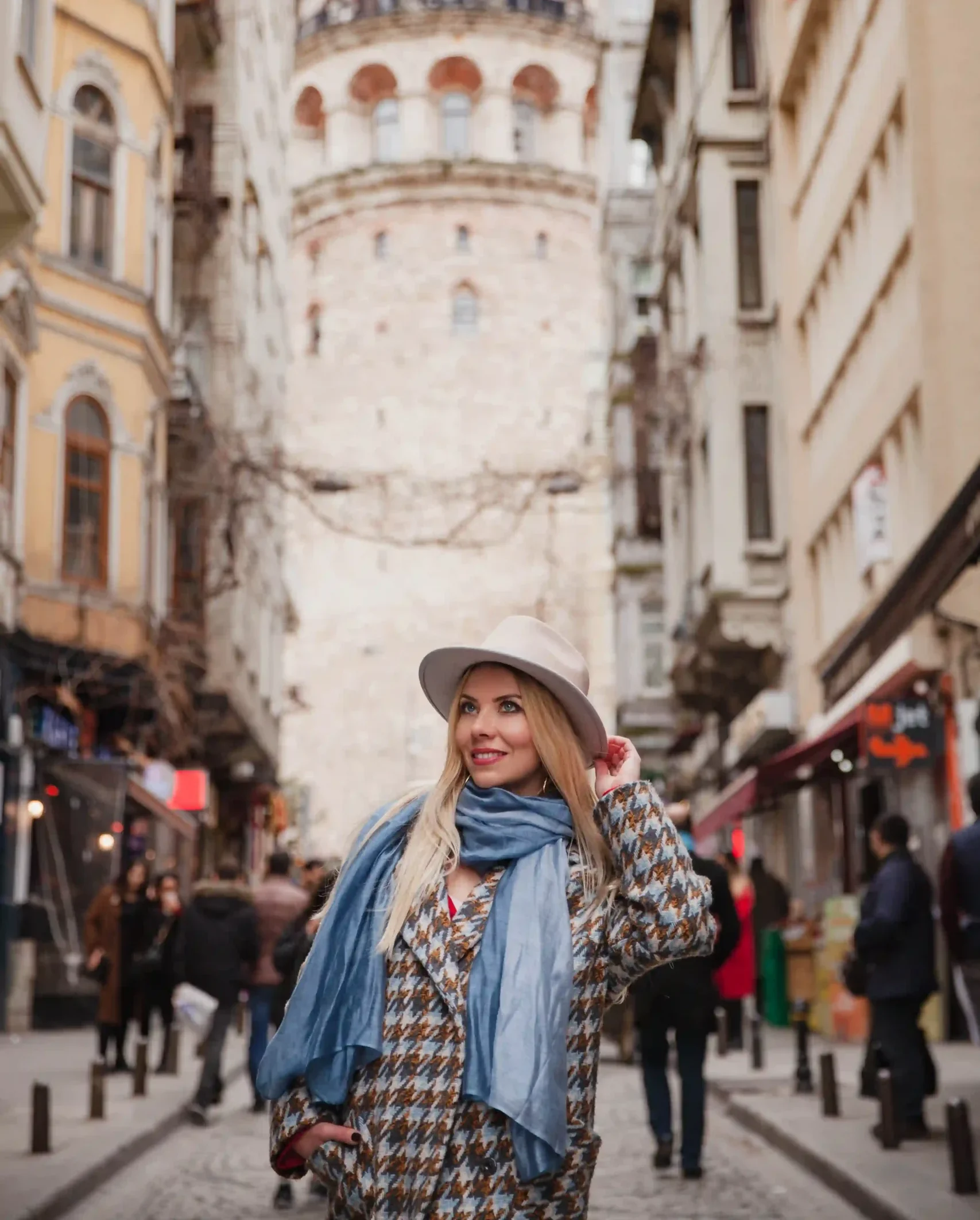
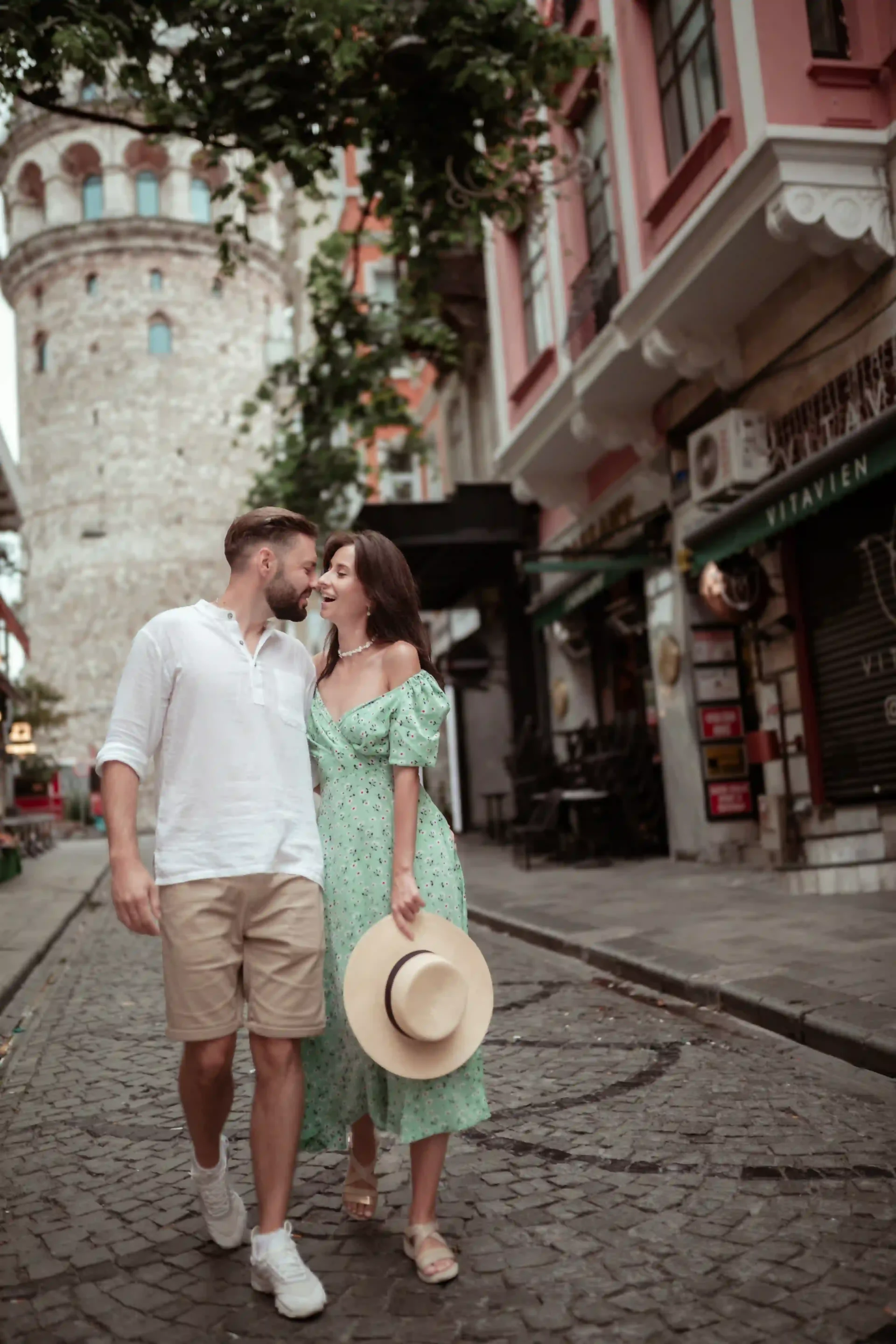
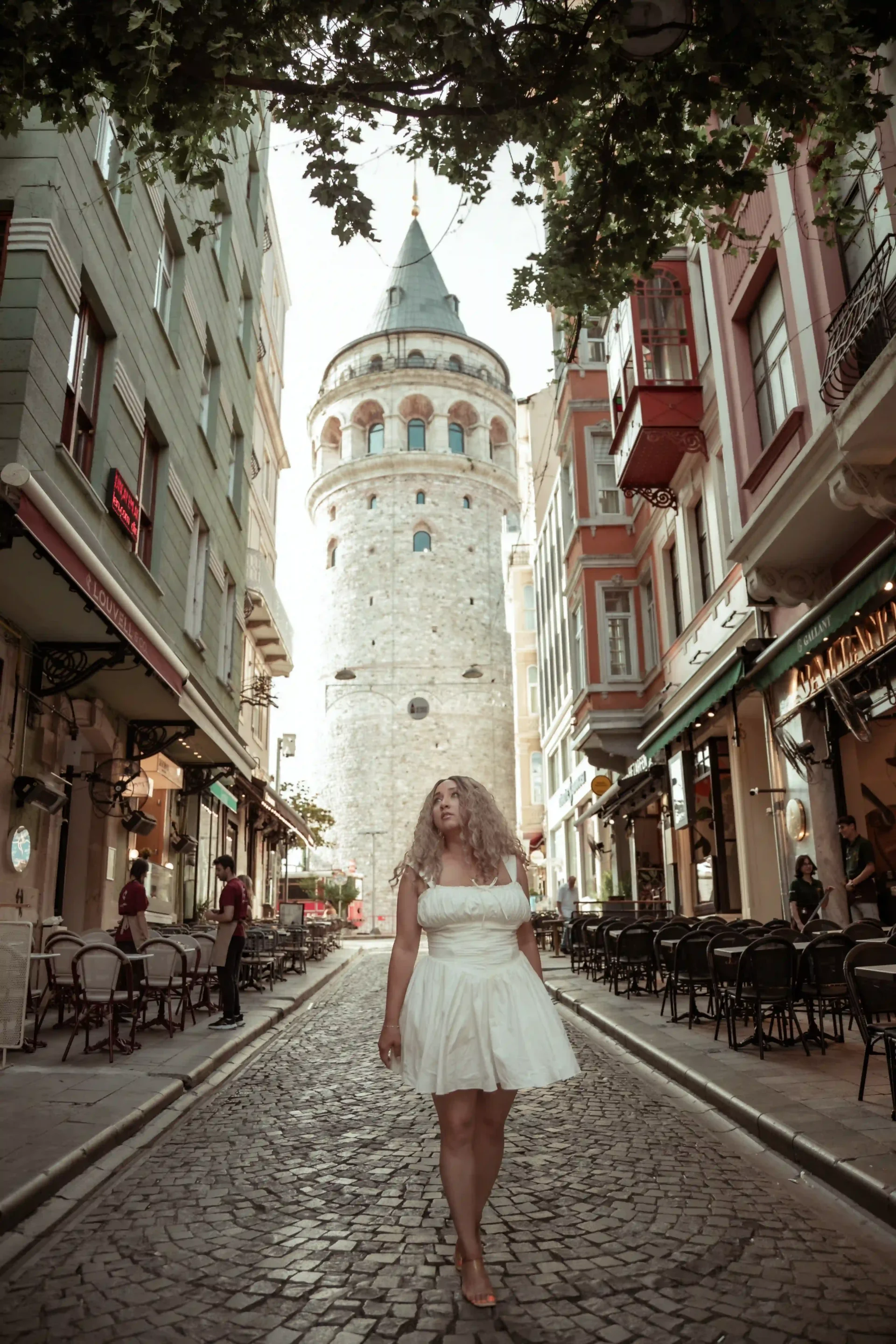
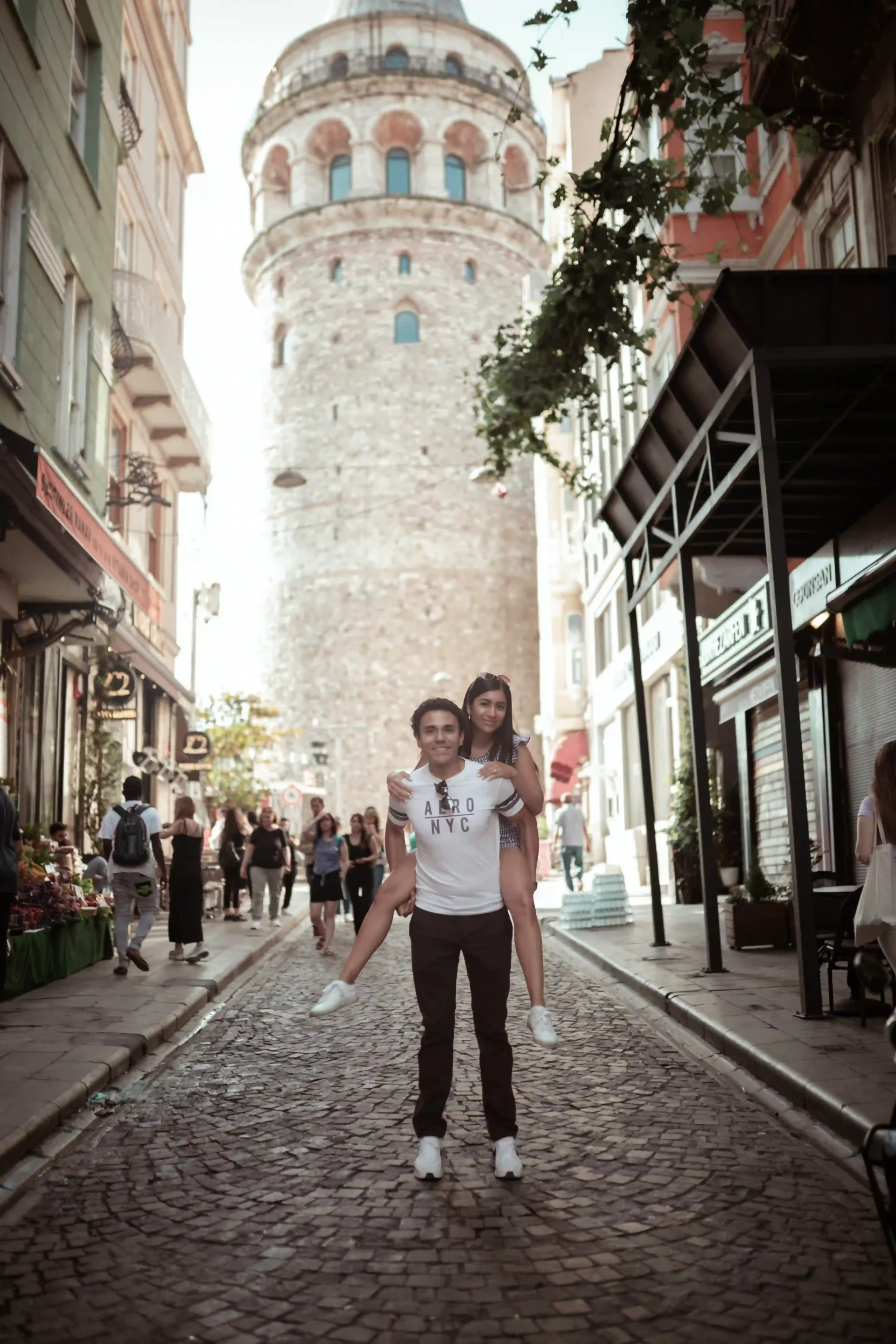
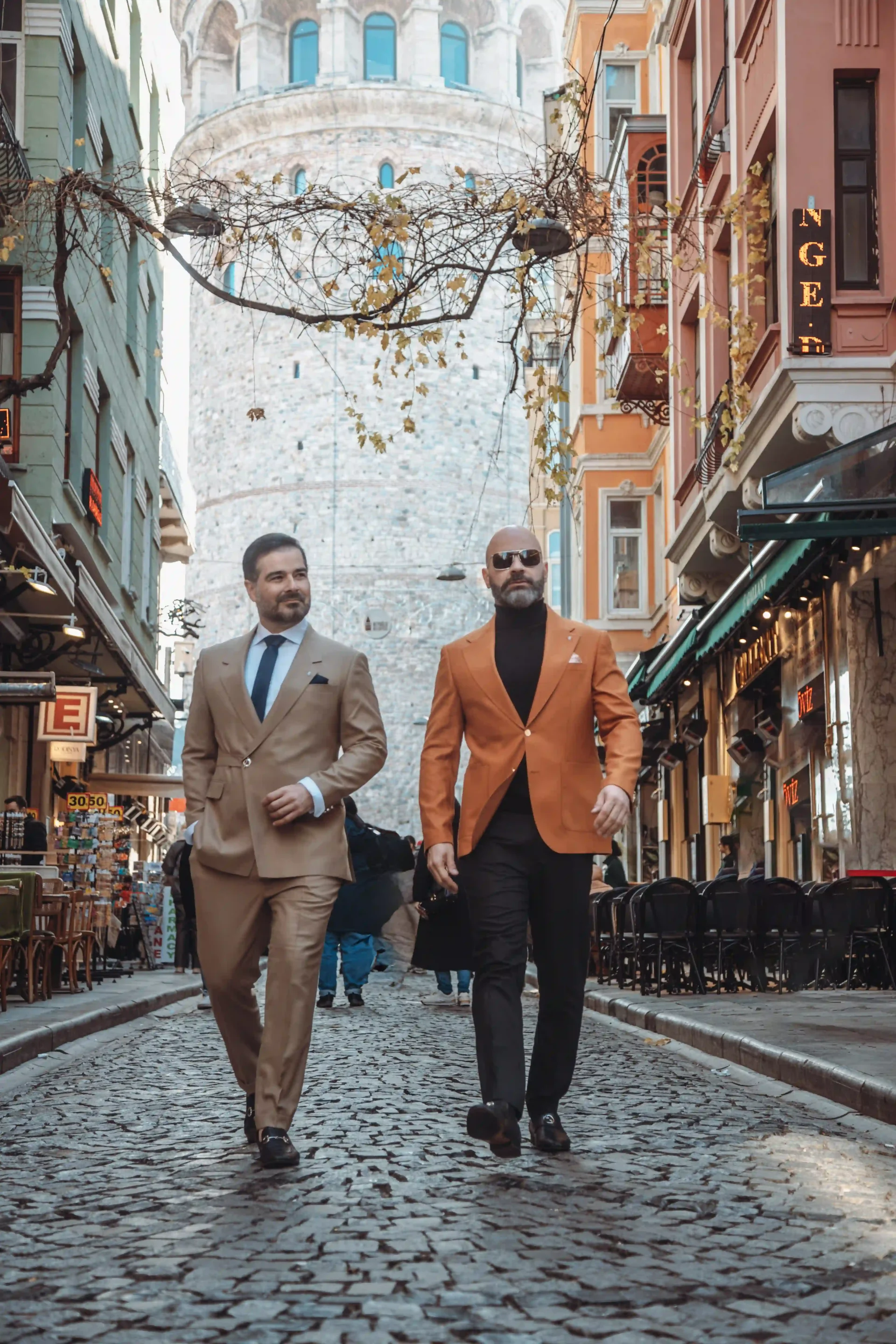
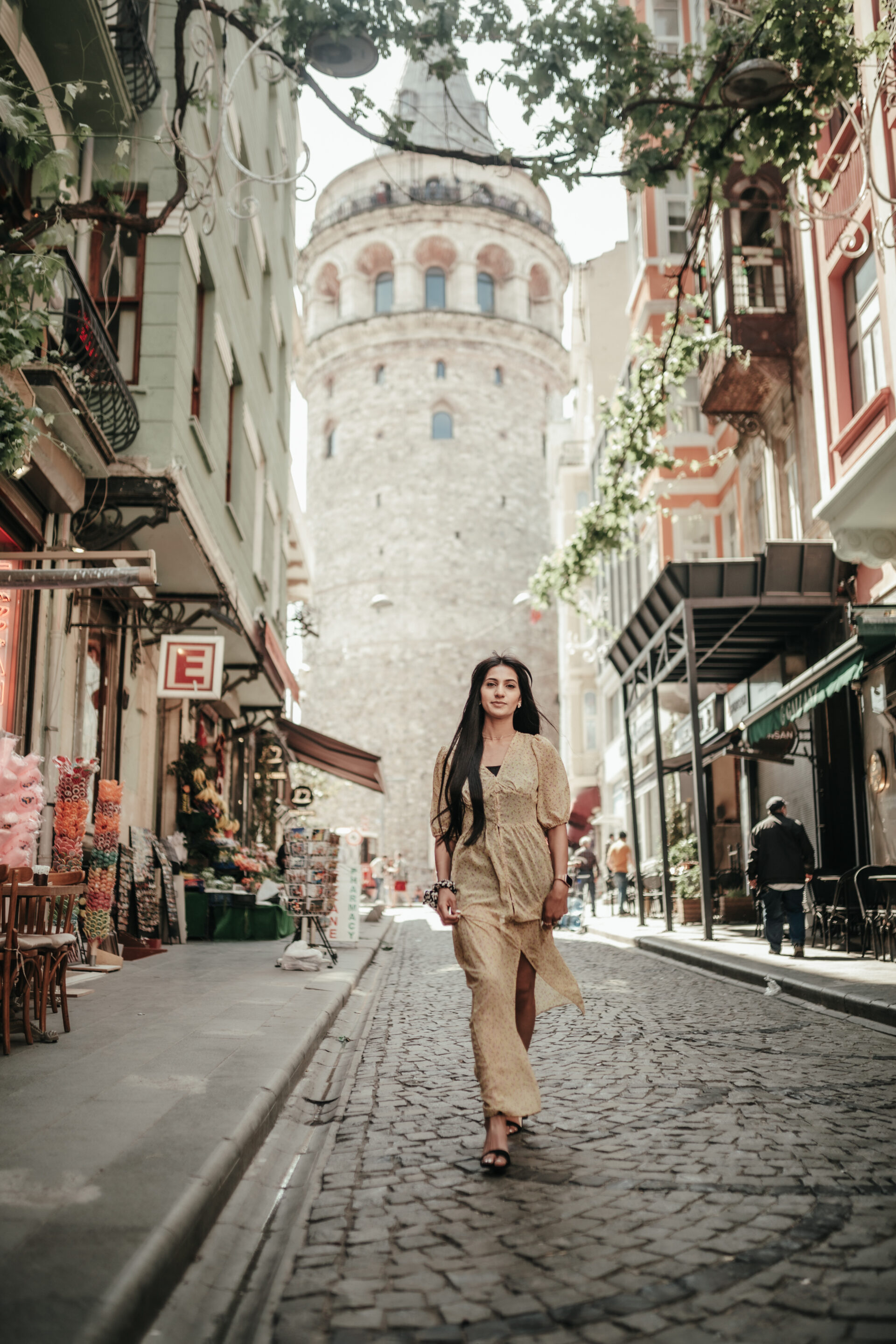
Whether you want to explore Istanbul’s history, take a walk on a lovely spring morning, choose an iconic spot for breakfast, or—most importantly—have a professional photography experience in Istanbul with a local photographer, I don’t think you would want to miss seeing one of the city’s most beautiful and most symbolic places. The Galata area, with its iconic tower, is like a jewel set in the heart of Istanbul.
I’ll try to use my own experience in Istanbul to open a window for you into this iconic, living district—so you can know it more deeply.
Last updated: jan 5, 2026 — transport tips + crowd timing refined.
Why Galata Is Special (A Local Photographer’s Perspective)
As an experienced photographer, I’ve always said this: for photography, nothing is more valuable than a living place. Galata might be a location for you, but for me—as a photographer—it is a living stage.
A place where every few steps the light changes, angles break, and a new story for photography begins.
From another perspective, time in Galata is not uniform. You can see a modern café beside a fourteenth-century building, or a tourist in today’s clothes walking through alleys that are more than a century old. This contrast is exactly what we call a photography paradigm. It is the paradigm that decides which moment is worth capturing: the subject, reality, history, the scene—or a combination of them.
Do you need a local photographer?
In a place where frames are not already neat and clean, where the light is not always perfect, where the subject is usually not at the center of the frame, and where the space itself speaks, the photographer must be able to control the moment—accept imperfection—and instead of safe beauty, chase visual truth.
That’s why two people photographing under the Galata Tower at the same time can end up with completely different results: one takes a postcard, and the other becomes the narrator of a story.
This is where the role of a local photographer reveals itself. Local Galata photographers on Tripskeeper understand what you want from the Galata area: a story-driven narrative, history, or a romantic postcard.
What You Will Get From This Guide
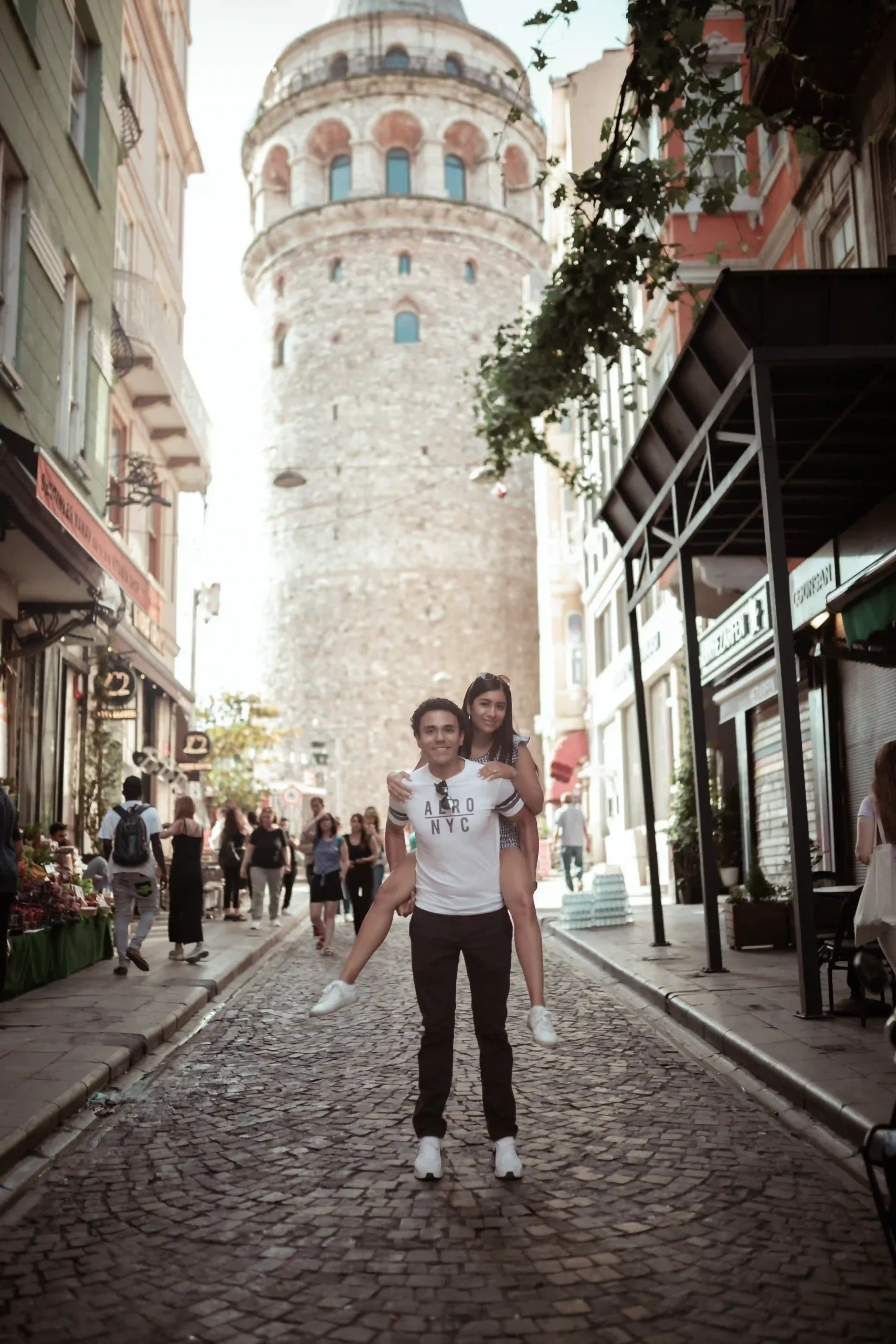
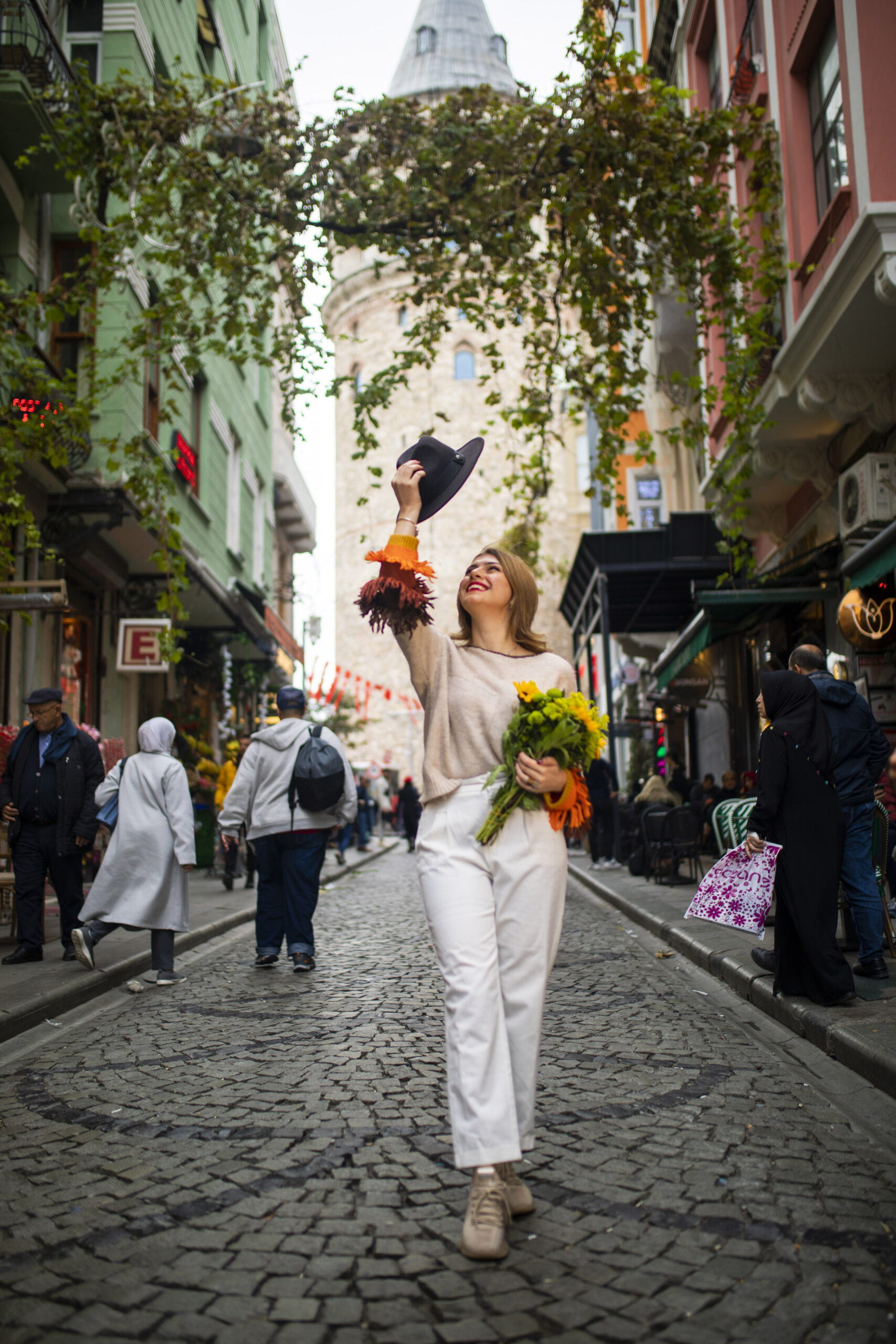
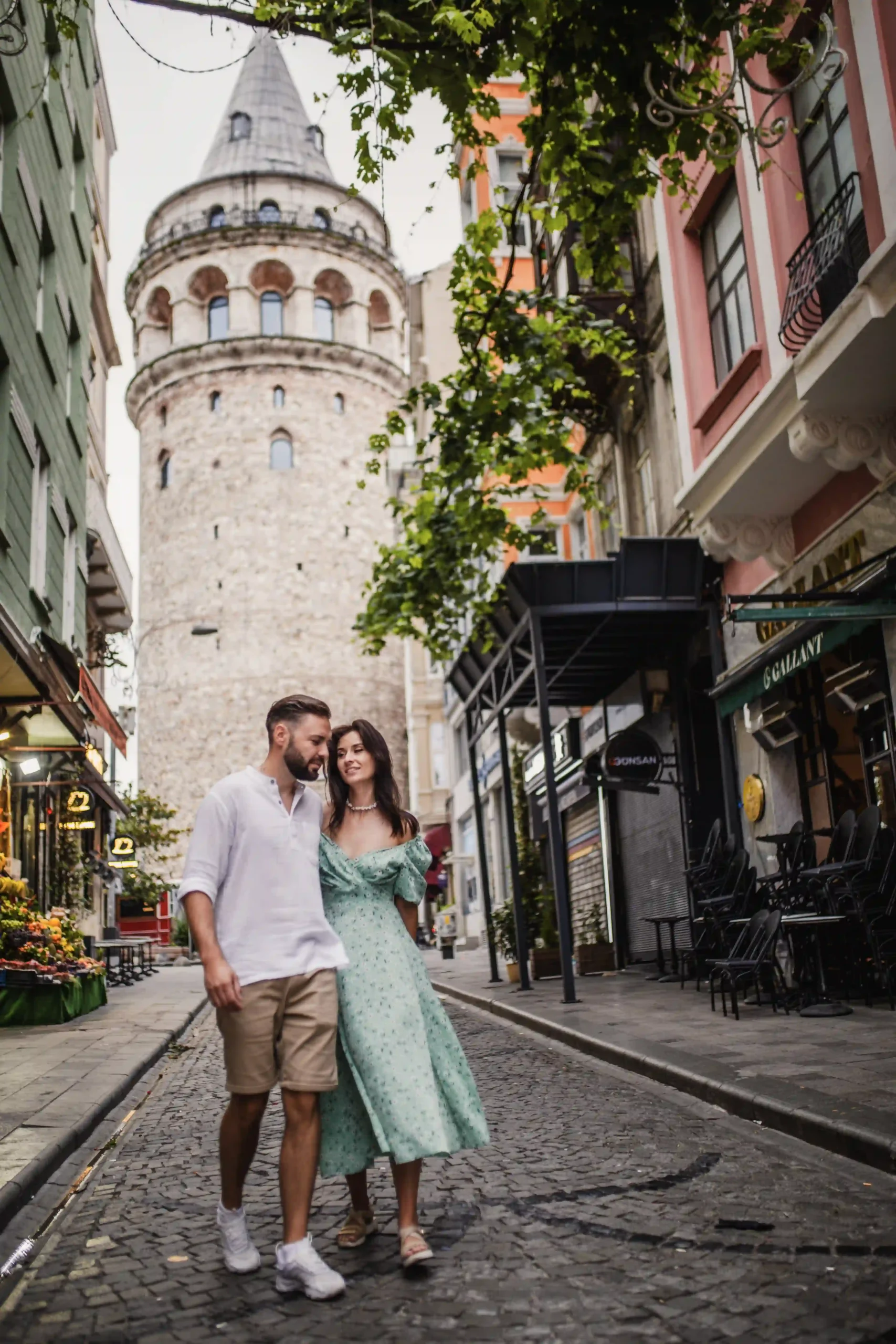
In this guide, you’ll receive a practical, real-world roadmap for tourist portrait photography in Galata—from understanding the neighborhood’s history and atmosphere to choosing the best routes to reach it, the best time of day and season to shoot, and even exactly where to stand so the Galata Tower can “be present” in your background without stealing attention from your face.
You’ll also learn how to handle Galata’s real challenges—crowds, harsh sunlight, safety in busy streets, and limited space—through solutions drawn from the hands-on experience of Tripskeeper’s local photographers, not generic, repeated advice.
In the end, this guide helps you turn an ordinary souvenir photo into a polished, lasting experience—by choosing natural poses, the right outfit (from simple styles to urban fashion and even a flying dress), and a clear, smart plan for your shoot.
History of Galata region
History is always the greatest guide for a beginning—any beginning. If you travel and choose an area or a neighborhood to visit, stroll through, spend time in, or photograph, knowing where you have stepped—who once walked these streets, who built this place, who lived here, and so on are questions that naturally appear in your mind. More importantly, the world becomes interesting when we understand why some neighborhoods have remained “alive.”
Galata is one of them—a place connected to history.
From the very beginning, Galata was never an ordinary neighborhood. During the Byzantine era, this area took shape as a place where foreign merchants lived and worked—outside the walls of Constantinople—where trade was freer than politics.
Galata tower structure
In the fourteenth century, the Genoese turned Galata into a powerful port city. It was during this period that the Galata Tower was built in 1348. At that time, Galata was not presented as a symbol; it was considered a tool for controlling the harbor and trade. In those years, Galata was a European-style town with its own walls, churches, and independent laws. If you have been to Trastevere in Rome or Montmartre in Paris, you will understand this the moment you step into the backstreets and narrow alleys of Galata.
After the conquest of Istanbul by Mehmed II, Galata was handed over to the Ottomans without conflict. This area was neither destroyed nor did it lose its identity; instead, it became a multicultural neighborhood where Muslims, Christians, and Jews lived side by side.
During the Ottoman era, Galata also maintained its position: it became a center of foreign trade, a place where diplomats resided, and a cultural bridge between Istanbul and Europe. This background is what makes Galata today one of the most vibrant and distinctive historical areas of the city—a neighborhood that has always been one step ahead of its time.
There are also neighborhoods in Istanbul that resemble Galata, such as Balat and Karaköy. But what sets Galata apart is that it is more international and more symbolic. In fact, not only does it have an older history, but it has also managed to assert itself to the world as an urban icon.
How to Get to Galata
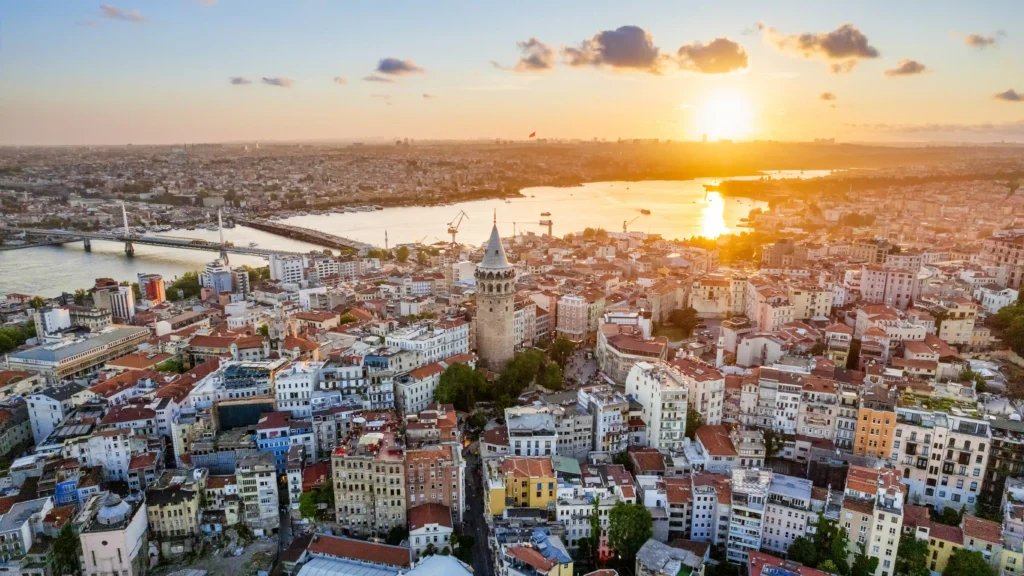
Since Galata is located right in the center of the city, it’s easy to understand why getting there is usually simple. Nearly two-thirds of Istanbul’s hotels are in this area or nearby, so whether you’re walking, taking a taxi, or using the metro, you can reach Galata without much trouble.
Walking Routes to Galata
For a curious traveler, walking routes are always more exciting. Galata is one of the few neighborhoods in Istanbul that offers walkable access at the same time from the sea, the modern center, and the historic fabric of the city. And it’s exactly this variety of routes that turns reaching Galata into part of the city experience—not just a simple transfer.
Imagine meeting other travelers along the way, passing through the daily flow of Istanbul’s people, discovering the visual beauty of each area, and at the same time avoiding transportation costs and the heavy, unwanted traffic that can sometimes be exhausting. That’s why in this section I’ll share a few strong walking routes with you.
You can see the walking routes that lead to Galata in a clear and separated way like this:
1. From Karaköy to Galata
The most common and most lively walking route.
It starts from sea level and climbs toward the tower through steep streets. This route is full of cafés, galleries, and urban details, and it carries the feeling of a “gradual entrance into history.”
2. From İstiklal Street (Taksim) to Galata
A higher, more urban route.
As you leave the crowds of İstiklal and enter the older side streets, the atmosphere suddenly becomes calmer and more historic. This route feels more local and cultural.
3. From Galata Bridge and Eminönü to Galata
A classic, tourist-friendly route.
After crossing the bridge, you reach Galata with a short walk and then a gentle climb. The contrast between the historic peninsula and Galata’s European texture is completely noticeable on this route.
4. From Şişhane to Galata
The shortest and easiest walking route.
It has less incline and is ideal for those who want to reach the core of Galata quickly, without passing through heavy crowds.
5. From Beşiktaş to Galata
This is a longer, more experience-based walk, and it is usually a combination of walking with a short ride.
From Beşiktaş, you can take the coastal walk toward Kabataş and from there continue toward Karaköy, then climb the steep streets up into Galata.
This route gives you the feeling of gradually moving from the open, horizontal Bosphorus into the vertical and dense texture of Galata. It’s especially appealing for those who want to experience the city’s changing face step by step.
Booking a Taxi (Uber / Taxi Apps) to Reach Galata
In Istanbul, people commonly use popular services like BiTaksi or iTaksi. They work similarly to Uber, and you can choose your exact pickup point and destination. (My suggestion is still Uber—I think it has a more consistent service.)
When you set your destination as “Galata Tower / Galata,” drivers often prefer to drop you at the bottom of the slope (Karaköy or the main streets) and then you continue with a short walk into the center of Galata, because the streets are narrow and winding.
Of course, this depends on the time of your ride. If it’s morning, you can usually reach the Galata Tower itself.
In general, booking from different parts of the city to Galata can be imagined like this:
- If you’re coming from the city center (places like Taksim or Mecidiyeköy): your taxi will usually take you to one of the main access points such as Sahne Sokak or the Şişhane area—places where reaching the tower is easy and where stopping makes sense for a taxi.
- If you’re coming from Karaköy / the Golden Horn waterfront: your taxi will bring you to a point close to Galata where a short uphill walk toward the tower begins. This route is a mix of narrow streets and small squares.
- For farther starting points like Ortaköy or the Asian side (Kadıköy): the app will show a direct route to Galata, but drivers often suggest dropping you at a practical stopping point, because direct taxi access to the upper parts of Galata is limited.
An experience
The advantage of this method is that—unlike Ortaköy, which often has a straight coastal route—reaching Galata by taxi feels like entering the heart of a historic city. The route passes through narrow streets, cafés, and small shops, it feels local, and finally it places you at a point where your walk becomes part of the Galata experience, not just a way to reach a destination. In other words, the taxi takes you to the “entrance of the experience,” not simply to “the tower.”
Always keep in mind that drivers often resist taking you to the closest possible point. This isn’t ideal, but if you have some Turkish (you can use translation apps), you can sometimes convince them to take you closer. Don’t forget: many locals and taxi drivers have very limited English.
Bus Routes to Galata (Safe, Low-Cost, and Convenient)
The bus won’t take you directly into the very heart of Galata. Instead, it drops you at one of Galata’s practical “entry points” (usually Karaköy or Şişhane). From there, the rest of the journey is intentionally on foot. You can use buses with an Istanbulkart—and of course, most buses and metro entrances also have card readers, so you can pay with your credit card or Mastercard as well.
The following four routes are the best bus options:
1. From Eminönü to Karaköy → Galata
One of the simplest routes.
Buses that run along the Golden Horn (coastal routes) will drop you in Karaköy. From there, Galata is about a 10–15 minute uphill walk. This route is ideal for people coming from the historic side of the city.
2. From Beşiktaş to Karaköy → Galata
The coastal buses running Beşiktaş–Kabataş–Karaköy are a common option.
After getting off in Karaköy, you continue on foot toward Galata. This route carries that feeling of moving from the open Bosphorus into a dense historic texture.
3. From Taksim to Şişhane → Galata
Some buses run from Taksim Square toward Şişhane or the lower parts of Beyoğlu.
If you get off at Şişhane, Galata becomes accessible with a short walk and a gentler slope—perfect for those who don’t want to climb the steep Karaköy route.
4. From Şişli and the northern parts of the city → Beyoğlu / Şişhane
Buses from areas like Şişli and Mecidiyeköy that head toward Beyoğlu can bring you to upper access points near Galata. From there, your walk toward the tower and the core of Galata begins.
Metro and Tram Routes
It’s true that metro routes to reach Galata are not always direct, but they are logical and well-connected, with plenty of useful stations. The metro takes you to what you could call “smart entry points,” and the rest of the route is intentionally a walk inside the neighborhood itself. Even if you are coming from a very distant part of the city, tram connections can still bring you close to Galata.
1. M2 Line (Yenikapı–Hacıosman) → Şişhane Station
The fastest and easiest option.
From Şişhane, you reach the core of Galata and the area around the tower with a 5–10 minute walk with a gentler slope. This route is ideal for those who don’t want the steep Karaköy climb.
2. M2 Line → Taksim Station → Walk to Galata
From Taksim, you can reach Galata with a 15–20 minute walk through Beyoğlu’s streets. The route is more urban and more energetic.
3. F2 Funicular (Historic Tünel) → Karaköy → Walk to Galata
One of the most unique ways to go.
You take the short-but-historic funicular from Beyoğlu down to Karaköy, and then continue with the uphill walk toward Galata. This route is experience-driven and especially popular with photographers.
4. Coming from the Asian side (Metro / Marmaray) → Karaköy or Şişhane → Galata
After crossing into the European side, your best choices are either Şişhane (gentler slope) or Karaköy (more experience-based). Both lead to Galata with a short walk.
Tram Route (T1 Line) → Karaköy Tram Stop
The T1 Tram Line, which runs from Kabataş to Bağcılar, is one of the most practical options for reaching Galata.
Once you get off at Karaköy, you’ll have only a 10–15 minute uphill walk ahead of you to reach the core of Galata and the area around the tower.
This route is ideal for people who:
- are coming from the historic district (Sultanahmet, Eminönü)
- or want to reach the lower entrance of Galata without changing transportation too many times
In tourist photography, the Galata Tower works like a silent witness: it doesn’t steal the story, and it doesn’t disappear from it either.
Key Photography Elements in the Galata Area
The Galata area is famous because of the Galata Tower. For many tourists, the first and most important visual element of this neighborhood is the tower itself. That’s why, before anything else, the photographic narrative of Galata usually begins from this point.
A stone-and-brick tower standing vertically against the sky—clear, powerful, and impossible to ignore.
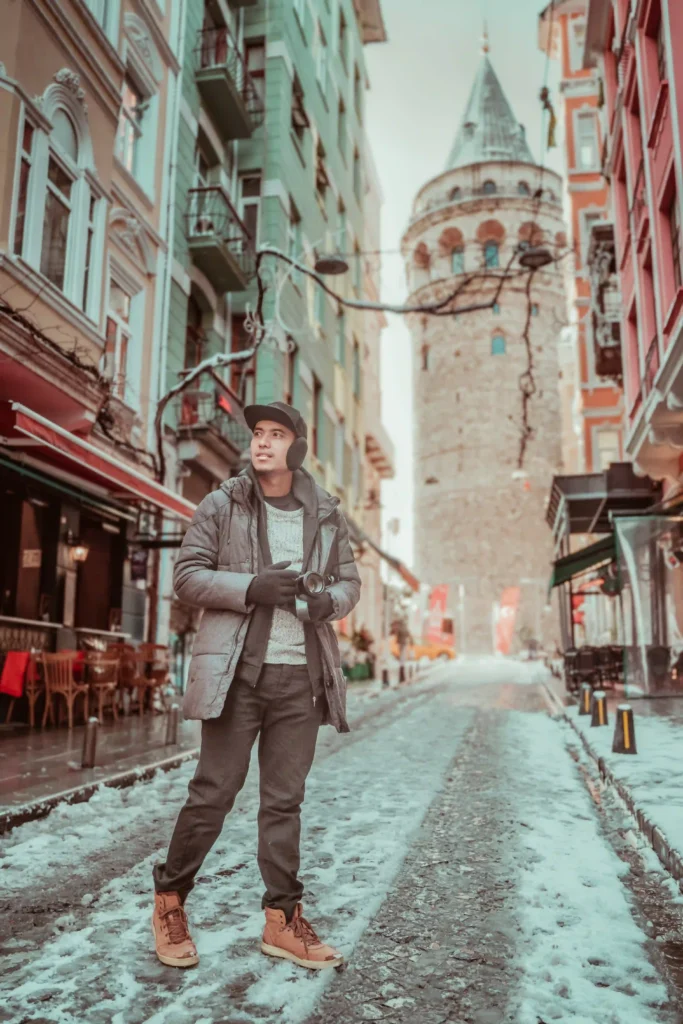
If it stands alone in the frame, it can unquestionably become the main subject of the photo. But my goal here is tourist portrait photography, and in my view, in a portrait the Galata Tower is not meant to be seen in order to “define” the image; it is meant to be present in order to confirm the place.
This means that when the tower sits in the background of a portrait, its role changes. It is no longer the center of attention—it becomes a calm sign, something the viewer notices with one glance, without the focus being taken away from the subject’s face. This quality makes portraits feel more natural, more like a real moment of being in the city.
The Galata Tower performs best in tourist portraits when it:
is seen, but does not explain;
is present, but does not interfere.
And it is exactly this deliberate silence that has turned it into one of the most memorable portrait-photography elements in Istanbul.
Galata Street
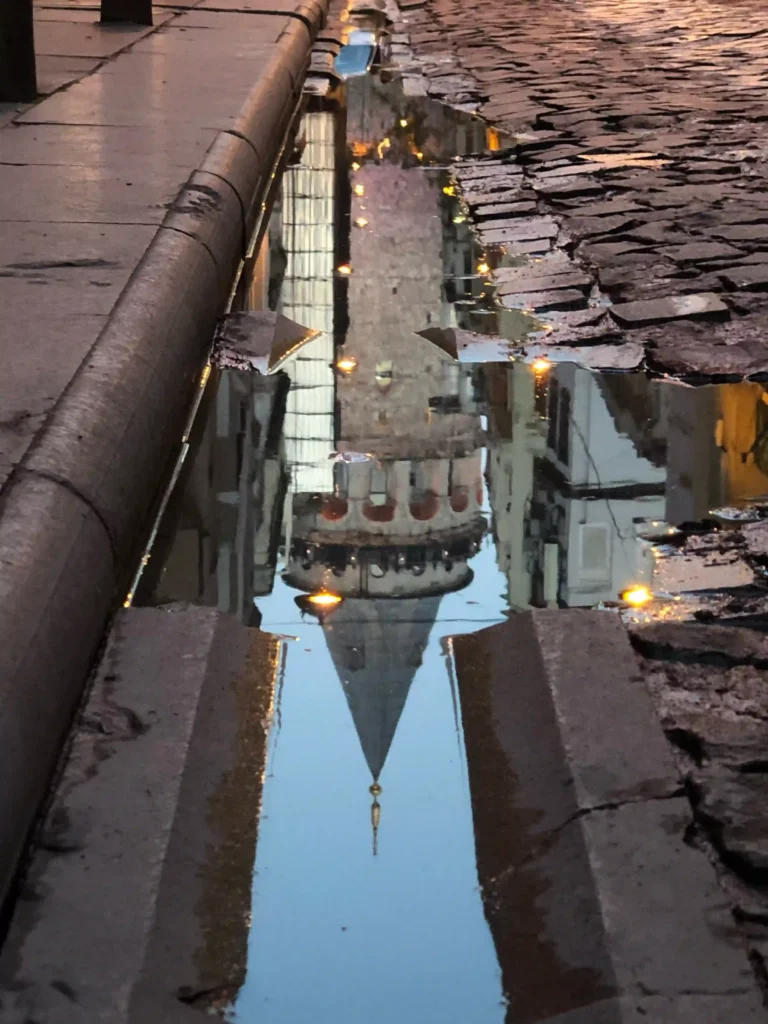
The magical Galata street (its beauty is beyond imagination).
On maps, the name of this street is usually registered as Galata Kulesi Sokak. The tower sits along the street and works like an “endpoint.”
It’s a classic perspective image that, together with other elements, looks surprisingly modern. All you need to do is follow the street’s stone pavement to reach the tower. Around it, walls in cream, gray, dark green, burnt brown, and faded patches create a natural urban palette.
Modern cafés—with colorful pastries and the warm glow of their small bright signs, usually sitting low in the frame. Along the sidewalk, chairs are arranged, and stylish local and foreign travelers sit there drinking tea or coffee or enjoying sweets.
When these details enter the frame, they work like a ready-made set and give the photo breath.
Hanging Plants That Look Beautiful in the Frame
In some frames, a piece of greenery or a branch stretches from one wall to the opposite wall.
This small element helps the frame close beautifully and gives the street the feeling of a “living space.”
The Always-Present Crowd
It’s safe to say there is no hour in the day when travelers—carrying a tourist mood—are not present on this street. From early morning until late at night, there is always movement. Mornings are lighter, but as it gets closer to midday—especially around two hours before noon—the crowd grows more and more.
Travelers with a unique style of clothing—almost as if they are different from other tourists in Istanbul. Bright, colorful outfits. Happy, exciting faces. They are less curious and more here simply to enjoy their time.
Light: The Main Secret of Galata
The Galata area has four completely different personalities throughout the day:
• Early morning (my recommendation for tourist photography)
Soft light, long shadows, cafés just waking up. On the main street, it is still shaded, but slowly the light enters the street. Tourists still feel like “guests,” not a crowd. If you want timeless frames with all the details of Galata, this is the best time—when Tripskeeper’s local photographers can photograph you at your best.
• Midday
The light becomes hard. Contrast rises, and the crowd gradually becomes heavier and heavier. I don’t want to discourage you into thinking you can’t take good photos at this hour. If you are photographing by yourself, you will face a challenge and you will need to include the element of crowd in your photography. If a Tripskeeper local photographer is with you, be confident—lively, dynamic street scenes will be captured in your background. And why not? You are a tourist, and having a crowd behind you can create a lasting memory. Through your photos, you will become the storyteller of a scene from Istanbul—for friends and followers on social media.
• Afternoon to sunset
Warm light, but uncontrolled.
If you understand the shadows, it’s excellent; if not, the frame collapses. Again, you need a professional local photographer who can choose the best frame. The crowd may not allow you to be very creative, so you may need to test different spots for photography.
• Night light
Like anywhere else, night light is always special, and you can capture stunning images in the streets around the tower. But don’t forget: you will still have a lot of crowd, which means it’s better to keep it to a few selfies or group shots with friends.
A Few Tourist Portrait Poses at Galata Tower (From a Local Photographer’s Voice)
If it’s your first time coming to this street, you will face many challenges for photography in this area—especially the question of where to stand so the Galata Tower is also in your frame. That’s why I’ll share a few possible scenarios with you, so you can build your best composition.
Of course, if you book Tripskeeper’s local photographers, they already know exactly where, when, and which position fits you best.
A professional local photographer understands that the Galata Tower is not “in conflict” with people. Unlike many massive monuments, its presence doesn’t make the subject look smaller. On the contrary, in the background of a portrait, it gives the photo the feeling of real life in the city.
1. Stand in the Heart of Galata Street, Close to the Tower—Where the Tower Shows Itself
Not exactly under the tower, and not so far that the tower becomes small and disappears.
Right where the street naturally guides you toward it.
Here, you don’t need a special pose.
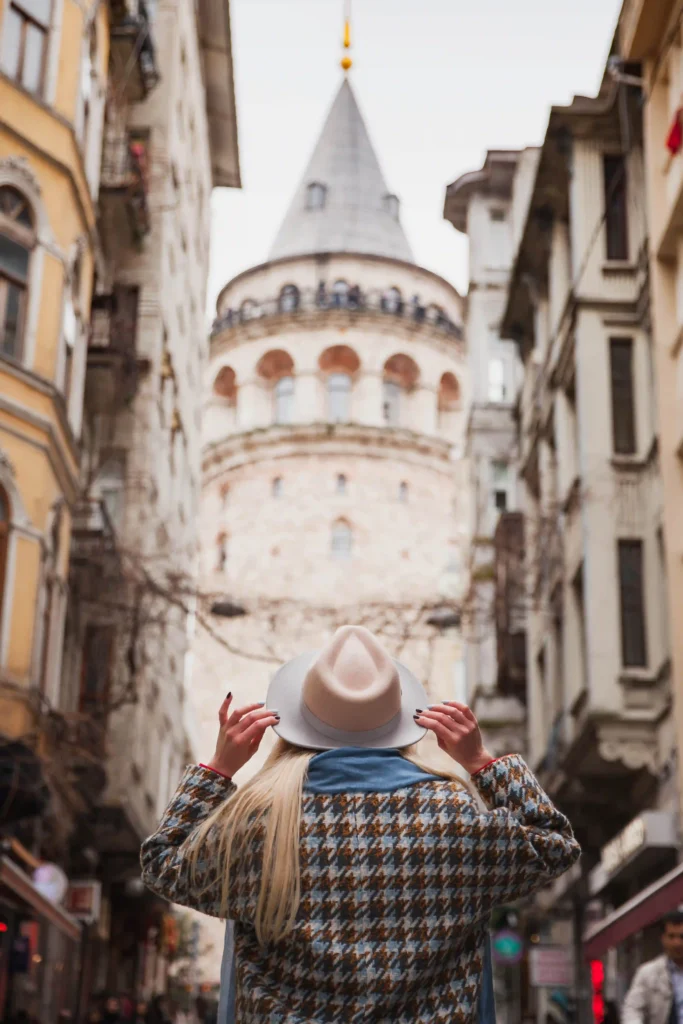
It’s enough to stand in the middle of the street, keep your body slightly relaxed, and let your gaze be forward—or a little to the side. Maybe you even prefer to turn your back to the camera and look at the tower. Raise your hand as if you’re “hugging” the tower. Do whatever feels natural and looks like you.
In this pose, you are part of a street that is alive.
The cafés, shops, color-worn walls, and the flow of people—everything moves in the background. If the crowd is seen correctly, it isn’t disturbing; it gives the photo a sense of “being real.”
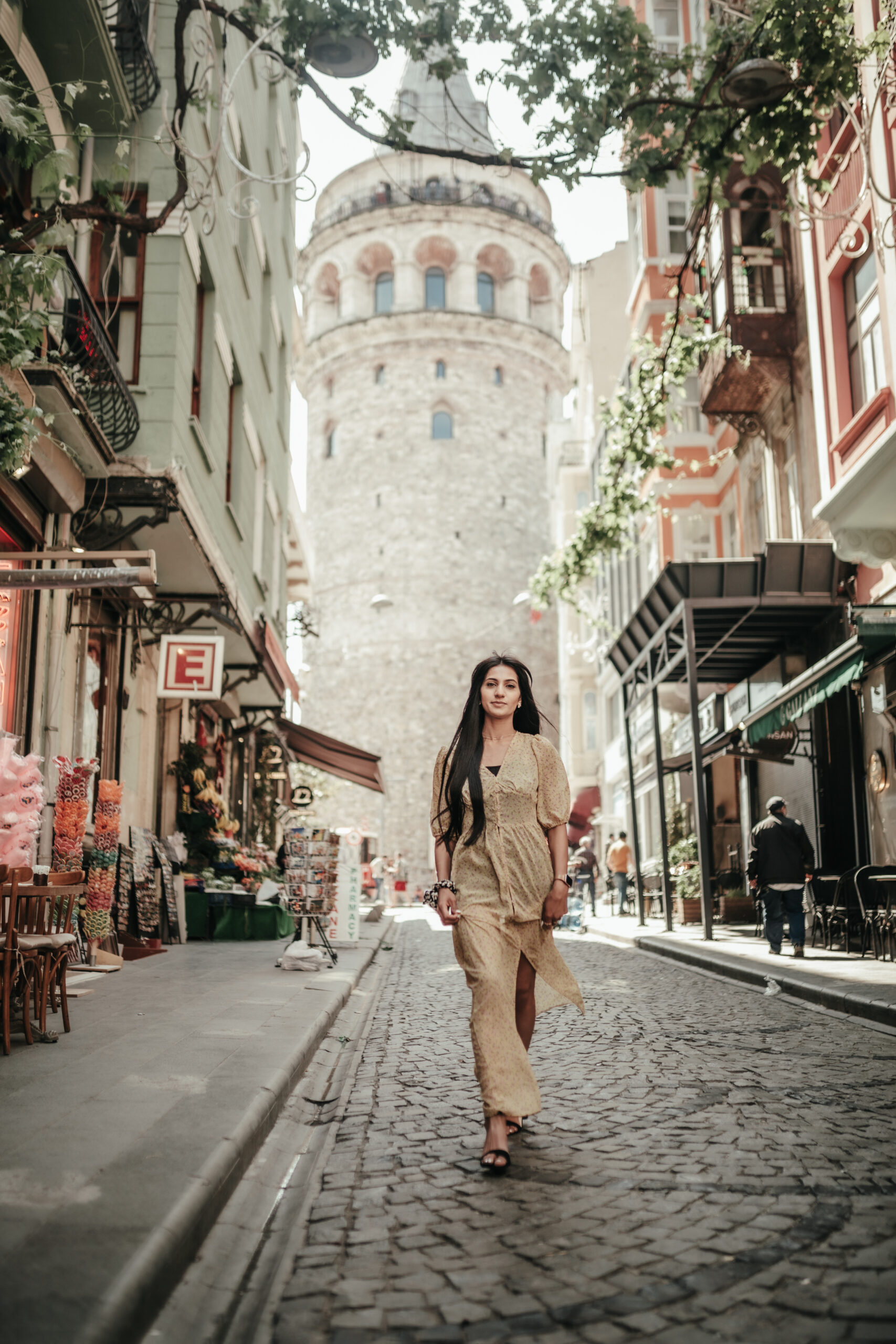
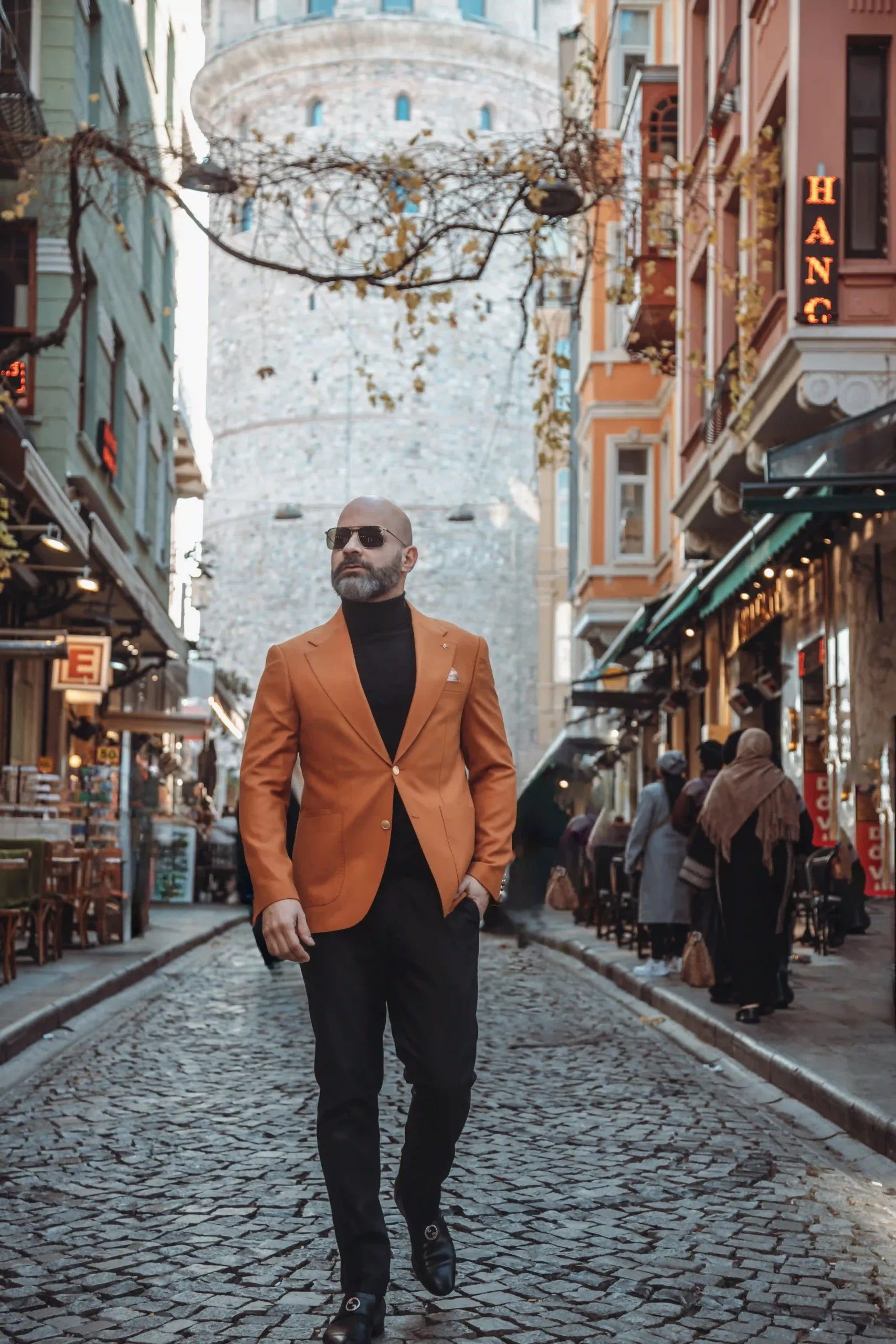
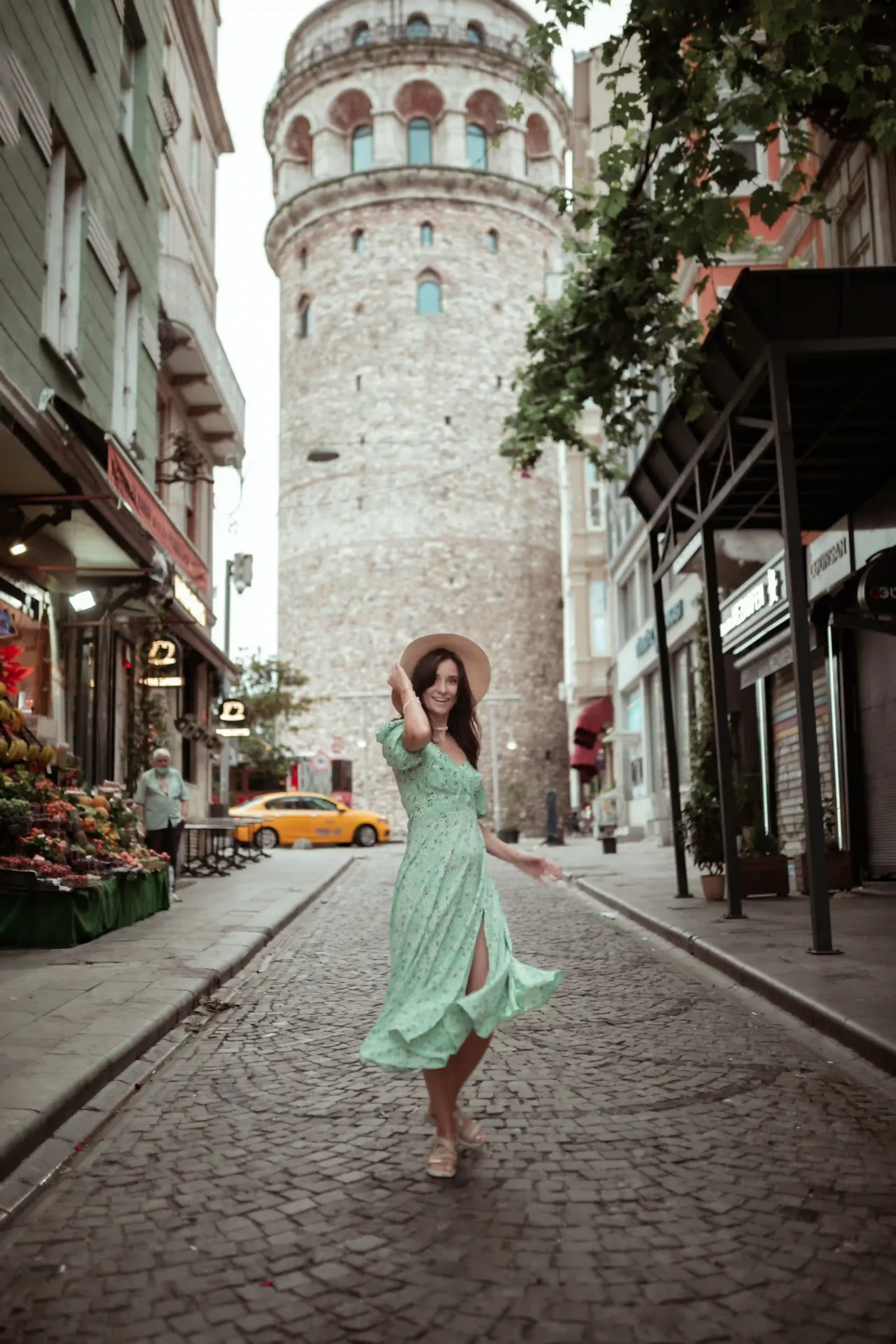
The best time for this pose is early morning—when the street isn’t crowded yet, the light is soft, and people aren’t rushing. At this hour, even if someone passes behind the frame, the photo won’t be ruined; on the contrary, it completes the feeling that you are truly there, inside the city’s movement.
2. Stand by the Wall—When the City Comes Closer to the Frame
This time, don’t stand in the middle of the path—stand by the wall. The wall beside you acts like a natural frame.
Those same walls with texture, with slightly faded color.
Here, your pose becomes more intimate without effort. The photo becomes tighter, the street’s chaos steps back, and the focus forms more clearly on you. People passing by—if they appear—become only the second layer of the image.
Your body is slightly closer to the wall, your shoulders are looser, and your gaze doesn’t need to face the camera. You can look a little downward, or forward, or as if you’re watching the street. And if you’re next to your partner, look at them—face to face.
In this pose, the tower is usually not fully visible—and that is exactly its strength. A part of the tower appears in the background, but not to show off; to say where this moment belongs.
This pose is for those who:
- don’t want to be “the center of attention,”
- but still want their photo to feel more real.
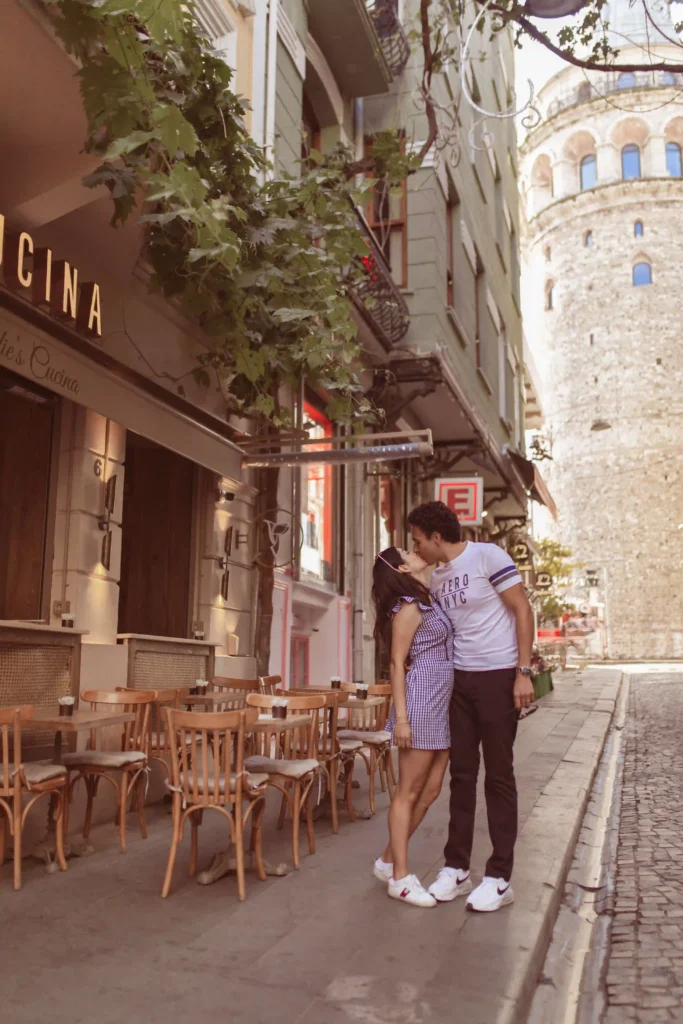
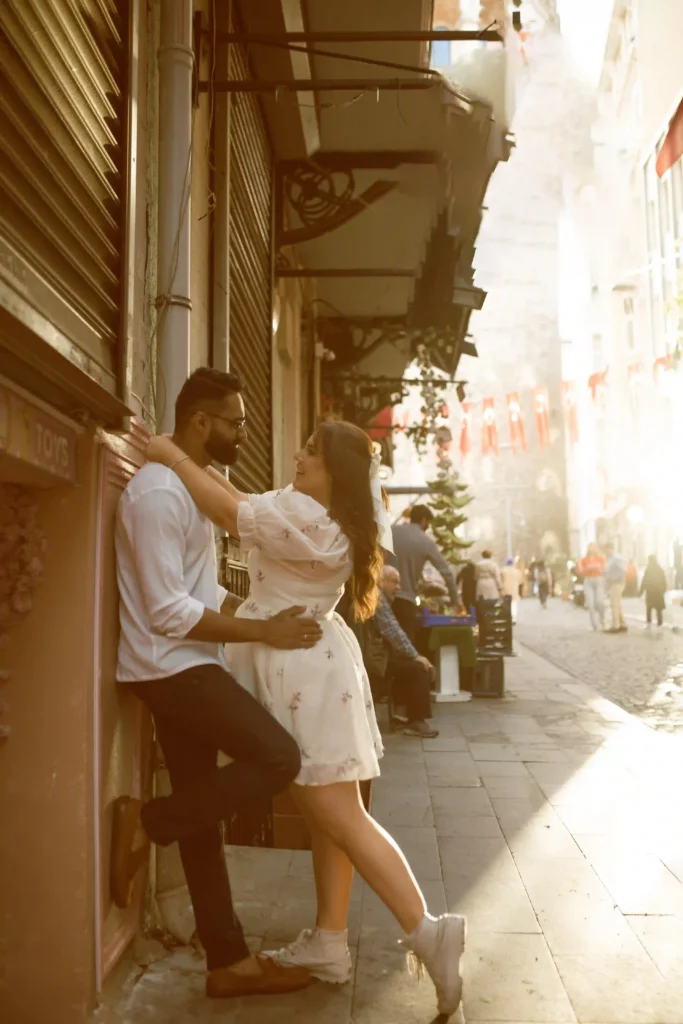
The best time is still early morning. The light sits gently on the wall, shadows are soft, and colors appear warmer. At this hour, even the smallest wall details—cracks, worn paint, and more—give life to the photo.
3. Sit on a Chair—When Galata Pauses
Imagine sitting next to one of the stylish cafés on Galata Street. The chair faces the street, a drink in your hand, and the city is passing in front of your eyes. This pose is not meant to be performative; it is meant to hold a real moment.
In this situation, your body is relaxed: a small lean into the chair, shoulders free, hands natural. Your gaze can be forward, toward the street, or slightly downward—like you’re lost in thought.
If your partner is beside you, maybe you’re holding hands. And if a smile comes, even better—the kind of smile that arrives naturally when a trip starts to feel good.
In this pose, the Galata Tower plays the role of a “quiet background.” It doesn’t need to be fully visible. Even if a part of it appears between buildings or above the roofline, it’s enough. Its presence signs the place, without interrupting your conversation with the city.
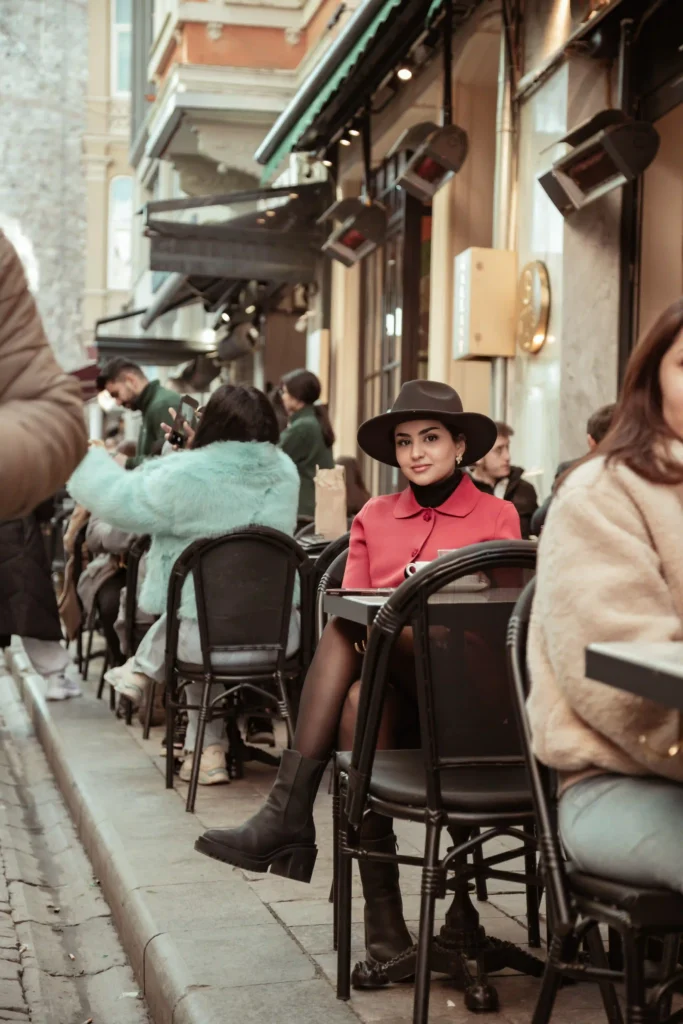
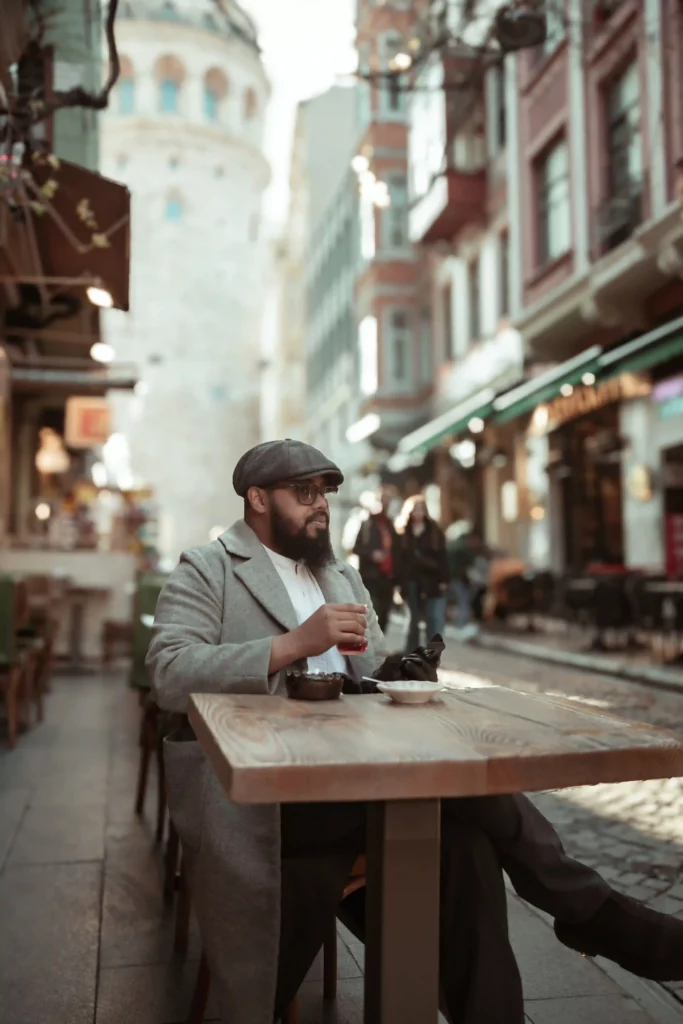
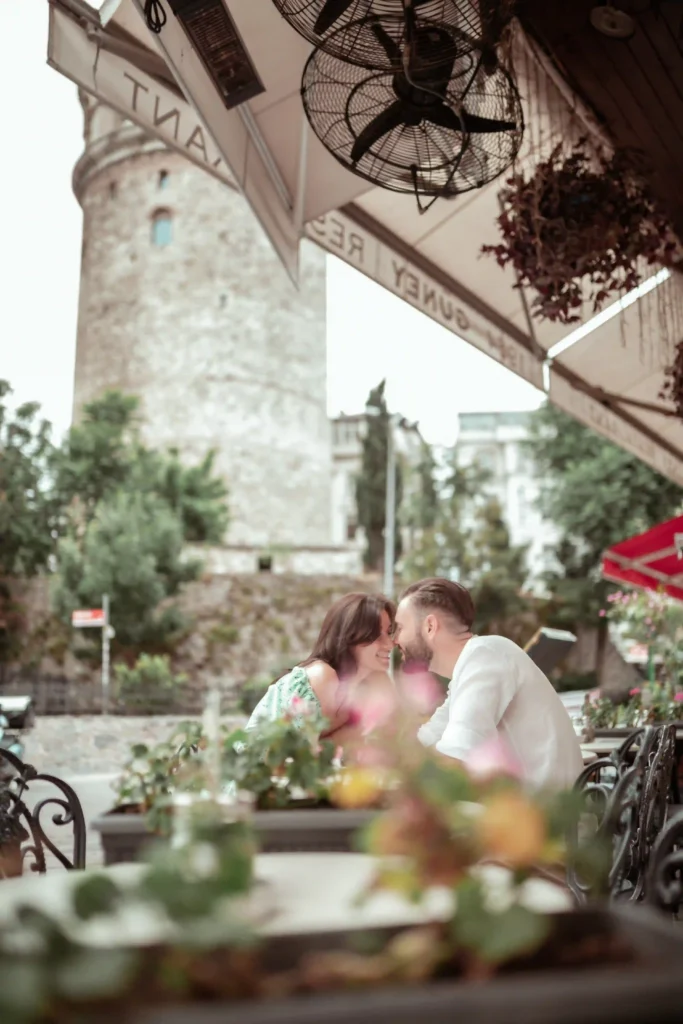
The drink matters—but not for showing off. The cup or glass works like a natural excuse for your hands, so the pose doesn’t look artificial. You can hold it near your lips, on your knee, or slightly lifted—whatever matches your mood.
This pose works best when the street is not crowded yet: early morning, or a little before the evening crowd builds. The light is softer, the sounds are fewer, and cafés still carry the feeling of “beginning.” At that time, even a few people passing in the background won’t ruin the photo; instead, they give it rhythm.
This pose shows Galata exactly as it is:
a city that, if you sit down and don’t rush, gives itself to you.
4. Step Back a Little—Where the Tower Becomes Smaller
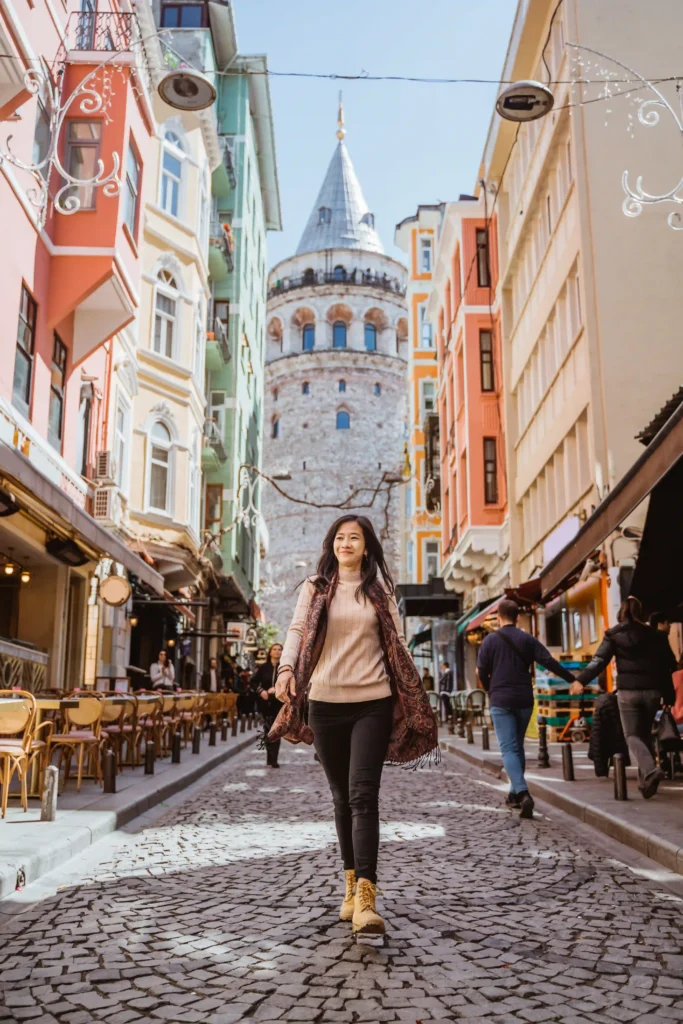
Imagine you’ve moved a few steps away from the tower—enough that it no longer fills the frame. Sometimes the best portraits are created exactly when you step back.
The tower is still visible, but now it plays the background and blends into the texture of the photo. At this point, your poses naturally become calmer. You can stand, walk slowly, or pause and look around. Your gaze doesn’t need to meet the camera; when the tower is smaller, the photo becomes more about your mood than about introducing the place.
Stepping back has one important advantage: when it is extremely crowded near the tower—around midday, when the flow of people doesn’t allow space for the frame. Frames feel tight, the space isn’t accessible, and you are forced to step away from the crowd to pose better.
When you move farther, the crowd slowly dissolves. Walls, windows, and street lines become clearer. You have “breathing room” in the frame, and the tower—silently—only reminds the viewer where you are.
5. Around Tower Square – Where Space Breathes
Right around the Galata Tower square—not so close that the tower swallows the frame, and not so far that it disappears. The space is more open, people move in circles, and the tower stands like a calm axis at the center of the scene.
In this pose, you are not meant to stay still.
A short step, a pause, or even a half-turn is enough. Your gaze can be around—like you’re watching the square.
The advantage here is that natural movement enters the photo. People pass in the background and you become part of the flow. If it’s crowded, it isn’t disturbing; the square spreads it out, and the image can breathe.
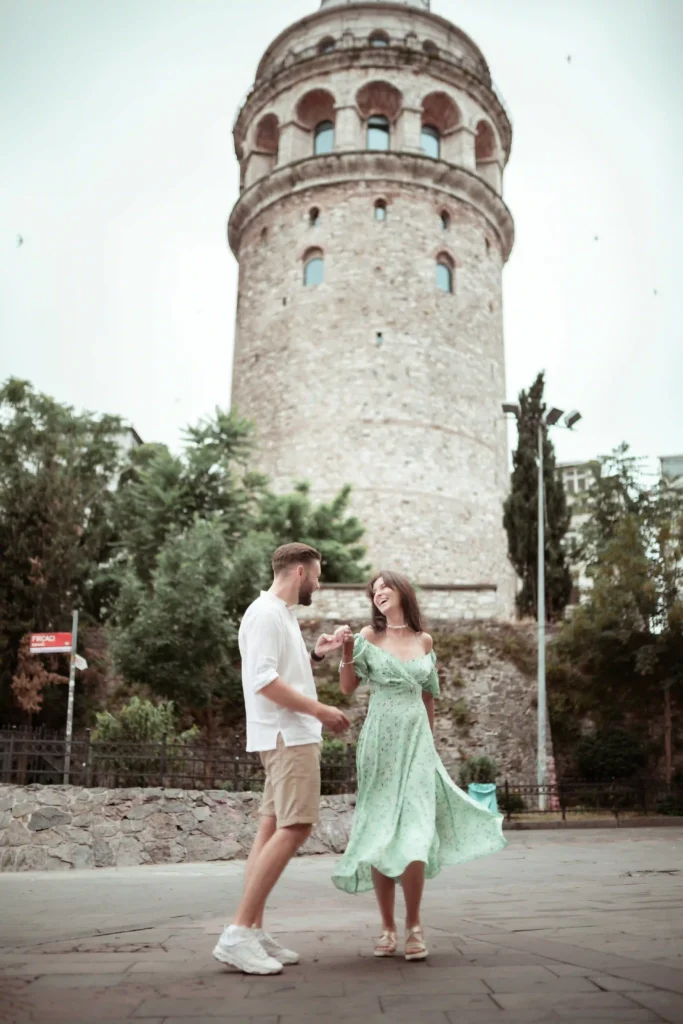
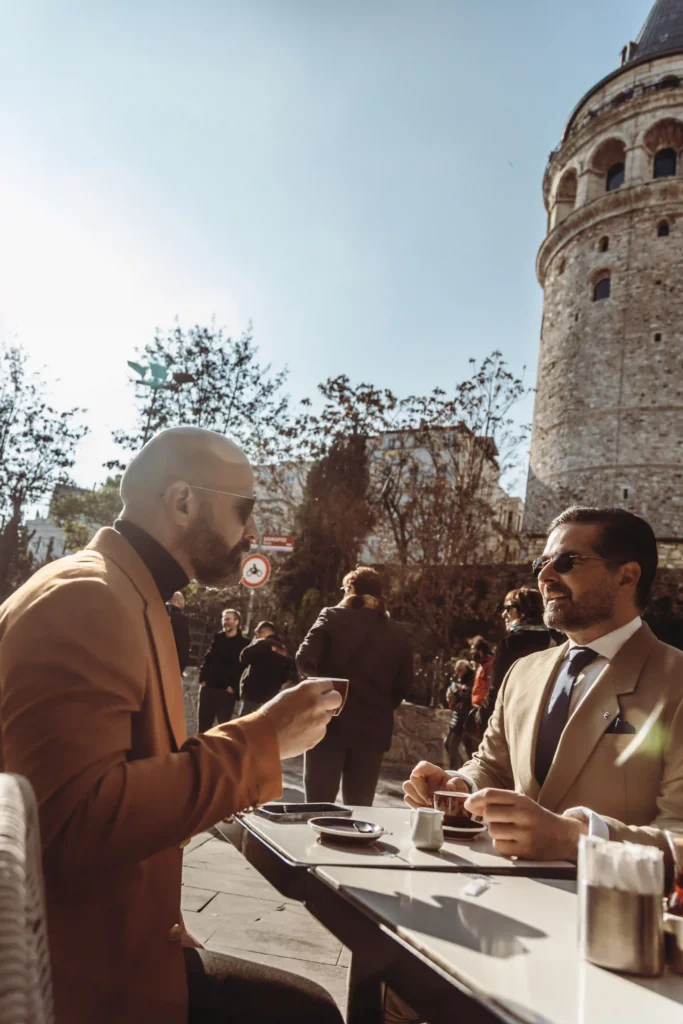
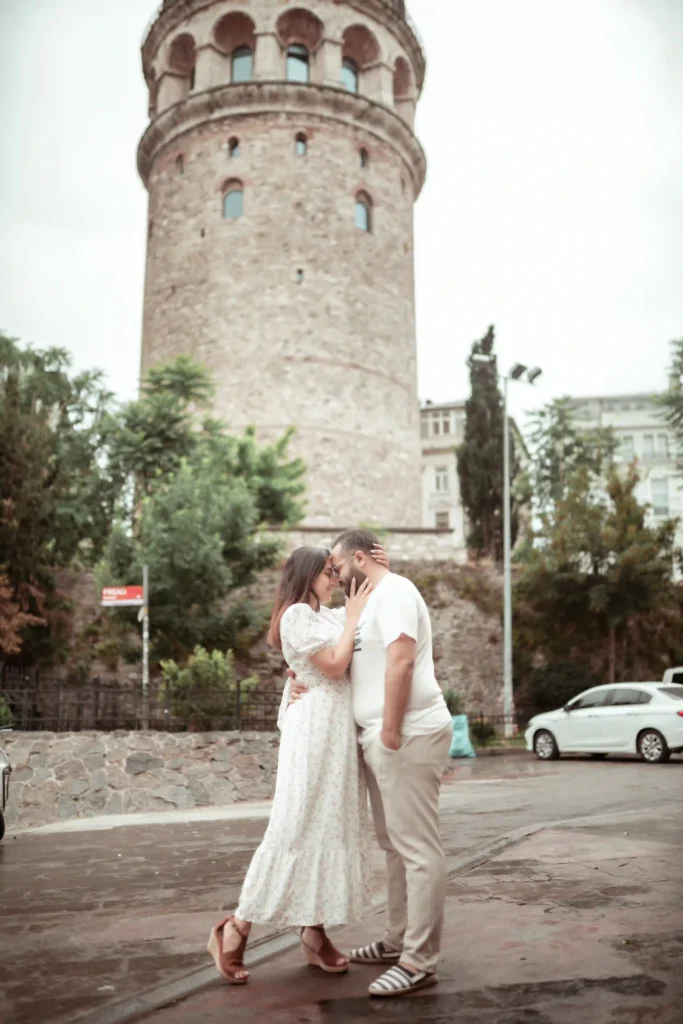
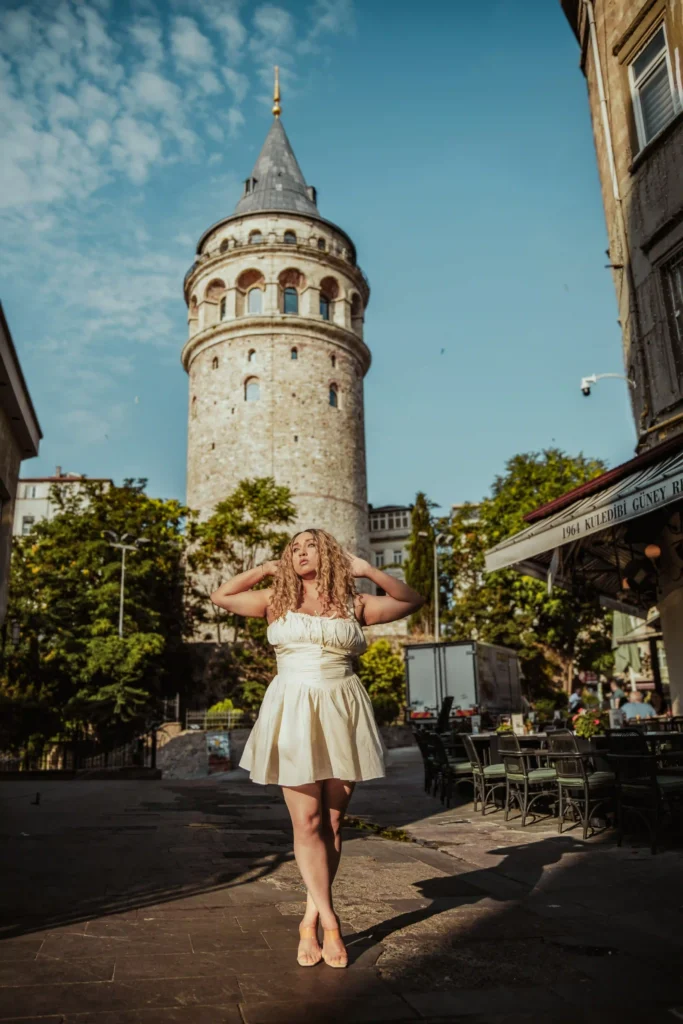
Light behaves differently in the square.
In the morning it is soft and even, with long shadows; in the afternoon it becomes warmer and the tower gains visual weight—without dominating. In both cases, your face stays the priority, and the tower remains a sign of the place, not the main subject.
What Should We Wear for a Photoshoot in Galata?
My personal experience says that most tourists who shoot in Galata wear the best and most stylish clothes they brought with them—not necessarily to show off, but because Galata is a place where, in one glance, you can see different cultures from countries around the world. A cultural gathering from everywhere.
That’s why Galata is a free and unlimited neighborhood in terms of clothing. There is no unwritten rule here, and no special cultural sensitivity. This freedom makes every style—minimal and simple, or fully dressed-up and branded—sit naturally in photos.
If I want to say it very simply:
- Wear something that gives you confidence.
- Something you want to remember from your travels.
- And preferably something that shows “you today,” not a role you are playing.
In Galata, you don’t need to become someone else. This neighborhood adjusts itself to you. When your outfit reflects your real mood, your photos—without any extra effort—become stylish and lasting.
Flying Dress in Galata—When Galata Street Turns Into a Stage
Among all the free and stylish outfit choices in Galata, there is one option that takes the photography experience to a completely different level: the flying dress.
Galata Street—just like the Ortakoy waterfront—because of its colorful walls, its stone pavements that are smoother than Ortakoy, and the calm presence of the tower, is one of the rare streets where this dress looks natural and cinematic, not exaggerated.
In the experience we have at Tripskeeper with local photographers, tourists can use a flying dress—an outfit that, instead of simply attracting attention, builds a narrative through movement. The fabric dances in the street wind, breaks the city’s vertical lines, and turns the portrait from a simple photo into a memorable image.
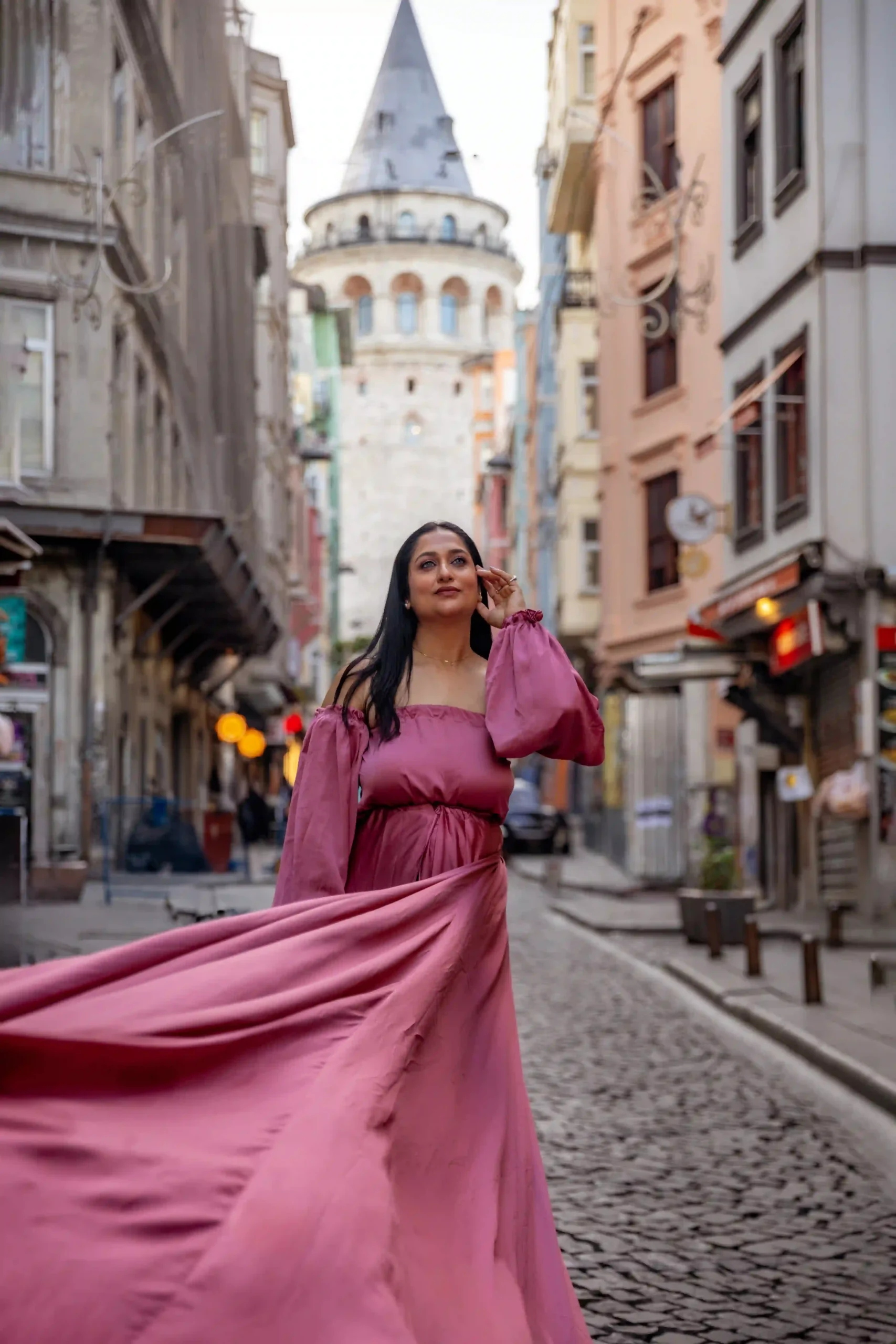
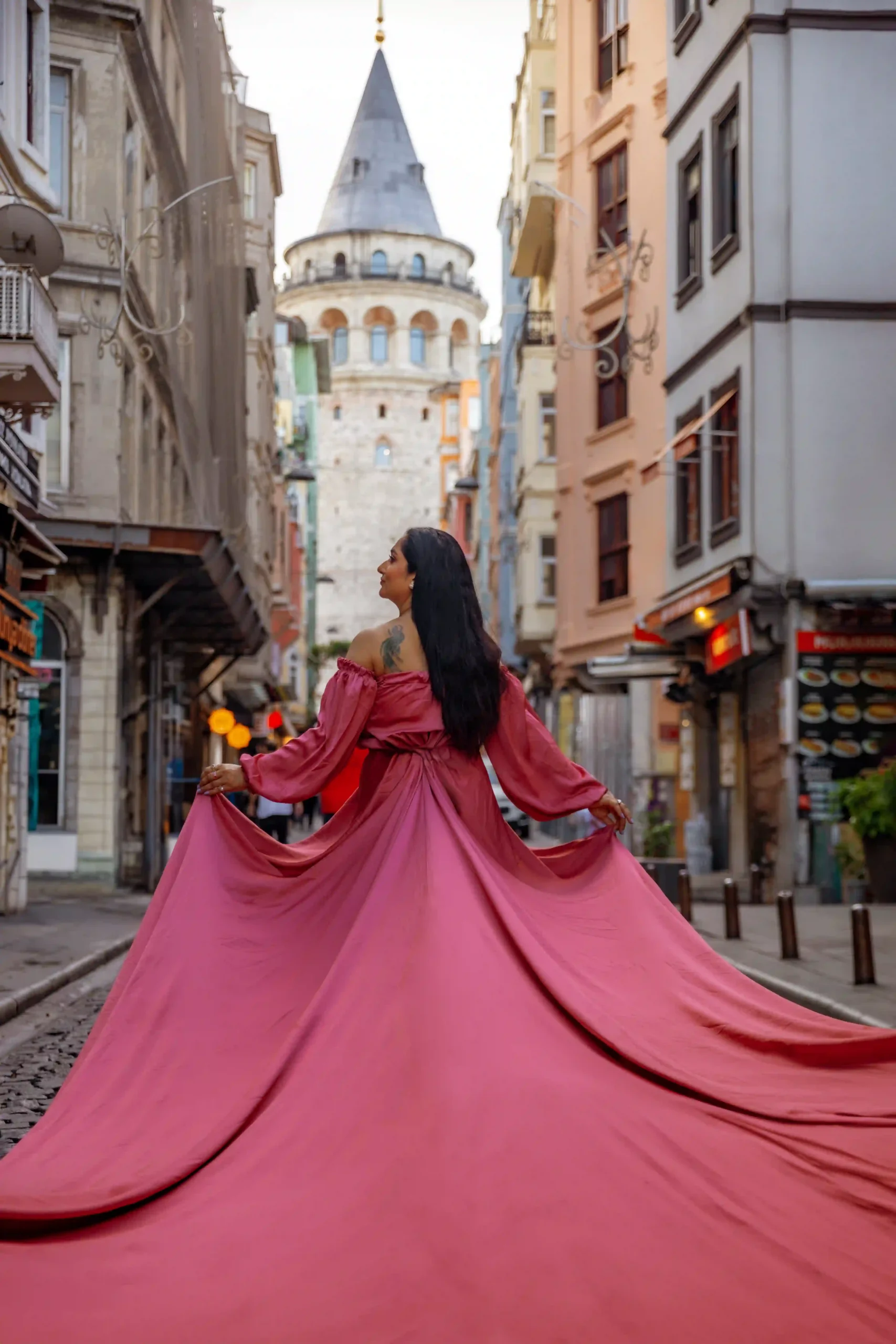
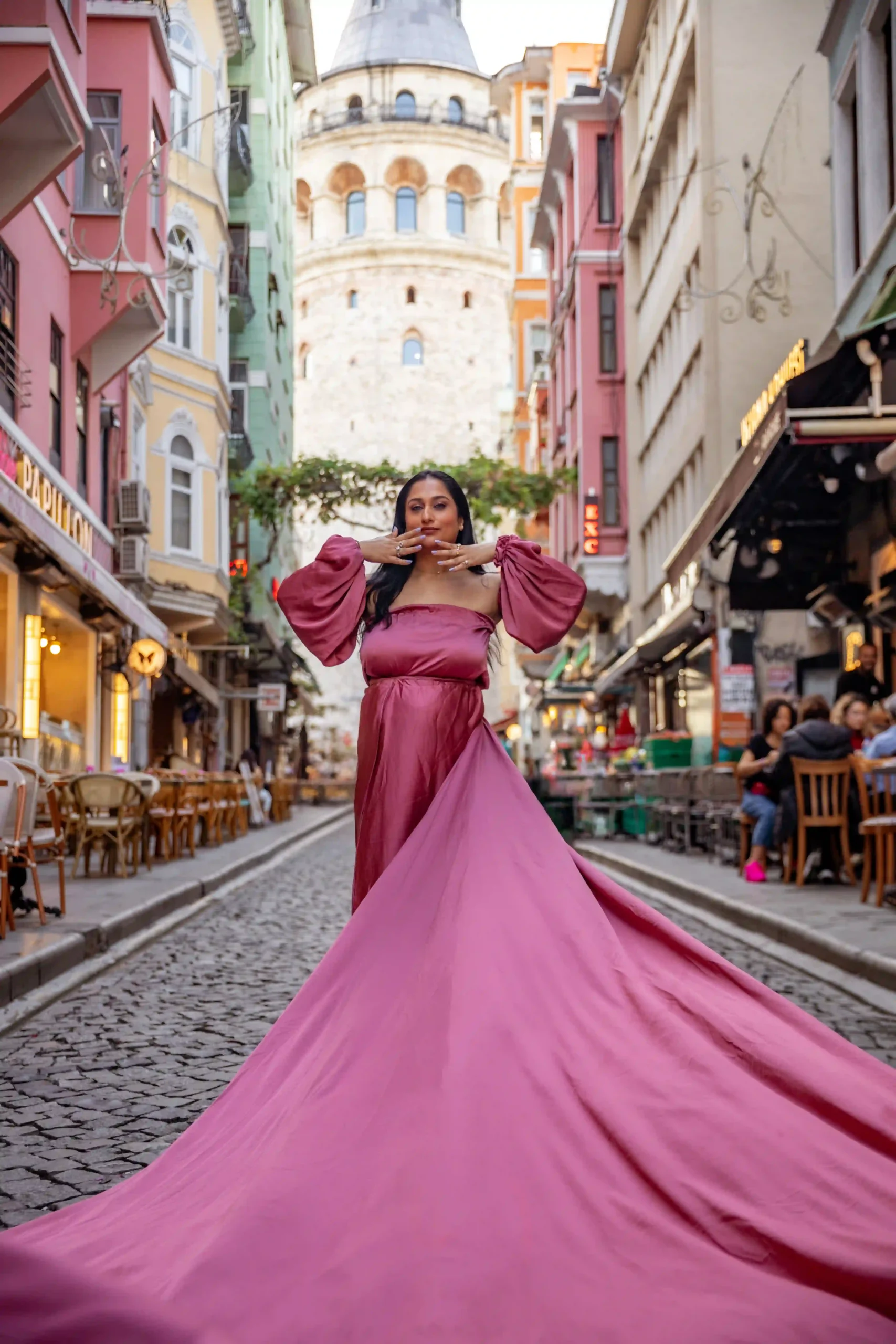
The key point is the time of shooting.
The best hours for a flying dress in Galata are early morning—from around sunrise until two hours after. In this window, the light is soft and controllable; Galata Street is quieter; and the movement of the dress looks more natural and more pleasing.
In these hours, Galata is still calm, and the space allows the dress, the city, and the subject to align together. It becomes a guided photography experience that—with Tripskeeper’s local photographers—is executed in the best time and best space: stress-free, natural, and exactly as special as it should be.
The Biggest Challenges of Photographing Galata (And Real Solutions)
Crowds—When the Street Swallows the Frame
The problem:
Galata is one of the busiest spots in Istanbul. In the middle hours of the day, the number of tourists becomes so high that the focus of the photo disappears, and the frame starts to look more like a crowd report than a portrait.
The solution:
Time is everything. Early morning—from sunrise until about two or three hours later (depending on the season)—the street still has room to breathe. If you miss that window, take a few steps away from the main axis or work close to the walls; the crowd becomes a background layer, not a disturbance.
Safety in the Middle of a Crowd
The problem:
In heavy crowds, attention gets scattered. A bag, phone, or personal items can be left unattended without noticing, and a feeling of insecurity transfers to the subject—and that feeling goes directly into the photo.
The solution:
Group photography or shooting with a local photographer practically removes this concern. When someone knows the area and is watching the surroundings, the subject becomes calmer and the photo becomes more natural. Safety is not only physical; it is the feeling of safety that makes a portrait look more real.
High Café Prices in Galata
The problem:
Some cafés in Galata—because they are popular and modern—have prices that can be higher than tourists expect, especially if you only want to sit for a few minutes or take a photo.
The solution:
You don’t have to use the famous cafés. Many smaller cafés—or even a short sit near outdoor chairs—give the same feeling without extra cost. The goal is the photo, not the menu.
Morning Delivery Vehicles
The problem:
Early mornings, vans and supply vehicles enter the street to restock cafés, and they may suddenly enter the frame and break the rhythm of the image.
The solution:
This is predictable. With a little patience or a small change of angle, you can remove them from the frame. Experience shows these movements are short-term and worth a few minutes of waiting—especially when you want that morning light.
Harsh Sunlight—When the Tower Fades Away
The problem:
Around midday—especially in summer—the sunlight becomes so intense that the Galata Tower in the background either blows out or practically disappears, and it loses its role as a location element.
The solution:
Either shoot earlier, or change your angle. When the light is harsh, work closer to the tower or in the square around it so the tower is seen in volume and form, not under direct light. Or let the tower become smaller and remain only as a quiet sign of the place.
A Short Summary
Galata is not difficult; it is time-consuming.
If you understand the timing, the angle, and the rhythm of the neighborhood, most problems solve themselves. And when the challenges are controlled, Galata becomes one of the safest, most alive, and most reliable locations for tourist portrait photography in Istanbul. These challenges are constant even for a local photographer—and they know very well how to face them.
What Photography Styles Is Galata Good For?
Galata is a neighborhood that doesn’t force one style—it can work with almost any style. But in real photography experience, these styles match Galata best:
- Tourist Portrait & Lifestyle
The most natural choice. A person blends into the city, not into a pose. Galata is excellent for photos that show “being there.” - Urban Fashion & Semi-Luxury
Stylish outfits—even branded and distinctive—don’t look exaggerated in Galata. The texture of the neighborhood keeps the image balanced. - Couple Photography
Walking, pausing, sitting in a café or in the square around the tower—without needing performative poses. Intimacy forms easily here. - Soft Urban Fine Art
If the crowd is controlled, Galata also has the capacity for poetic and calm images—especially in the mornings.
Galata is not suitable for completely formal, very studio-like, or overly controlled photography.
Here, the city needs to breathe.
In Galata, How Many People Is a Photoshoot Best For?
In general, Galata delivers the best results for small groups.
- One person (Solo Portrait)
The most ideal option. It’s easier to control the space, and the relationship between the person and the city appears more clearly. - Two people (a couple or close friends)
Very suitable—especially while walking or during short pauses. The photos stay natural and alive. - Three people
It can work, but it requires more precise timing so the crowd doesn’t take over the frame. - Four people or more
Usually not recommended—unless it’s during very quiet early-morning hours. The surrounding crowd plus the number of subjects makes the frame feel crowded very quickly.
Galata is a neighborhood for small gatherings;
the fewer people, the more personal the photo.
Precise Timing and Ideal Seasonal Conditions for Photography in Galata
Spring (March to May)
- The best season for photography
- Balanced weather, soft light, a lively street that is still controllable
- Early morning until around 9:30 AM is the most ideal window
Summer (June to September)
- The busiest season
- The only suitable time: sunrise until a maximum of 8:30 AM
- After that, the light becomes harsh and the crowds grow
Autumn (October to November)
- Very suitable for calmer portraits
- Warmer light, fewer crowds
- Early morning and late afternoon close to sunset are the best choices
Winter (December to February)
- The quietest season
- Soft and different light, but the weather is cold and sometimes rainy
- Excellent for emotional and minimal portraits
Conclusion: Galata—A Lasting Experience When Planned Well
Galata is a place where tourist portrait photography—if done properly—turns from a souvenir photo into a real experience.
When you know how angles, distance from the tower, and even simple pauses can make a portrait feel more natural; and why timing—especially early morning—is the most important factor for a good photo; when you also understand how stylish outfits or even a flying dress can match Galata’s texture; and how challenges like crowds, harsh light, or heavy movement can be controlled by knowing the neighborhood, you arrive at one shared point:
Galata is not a location you can photograph casually, by accident, and without a plan.
expert local photographers
This is where Tripskeeper becomes meaningful.
By working with local photographers who know Galata’s rhythm, choose the right time, and suggest the right route, the photography experience turns from a high-risk task into a calm, precise plan. From choosing poses and the best shooting hour, to outfit guidance—and even the option of using a flying dress—everything becomes coordinated so you can focus only on the moment.
In the end, Tripskeeper’s goal is not simply to capture one photo in Galata.
The goal is for the tourist to know where, when, and how to shoot to get the best result—without trial and error, without worrying about crowds, harsh light, or choosing the wrong spot.
Tripskeeper is built on two principles:
First, smart guidance before the shoot—helping you choose the best time, route, style, and ideal conditions for photographing Galata.
Second, direct connection to expert local photographers who have lived the neighborhood in detail and know how to capture a tourist portrait that is natural, safe, and lasting.
This is how photography in Galata moves from an accidental experience
to a clear and trustworthy plan—
a plan that creates a stronger visual result and a calmer experience for the traveler.
And this is exactly where Tripskeeper becomes a brand:
not through promising photos,
but through helping travelers make the right decisions for travel photography.

Hey There. I found your blog using msn. This is a very well written article.
I’ll make sure to bookmark itt annd rreturn to read more
of your useful information. Thanks for the post. I will certainly
return.